Contrast Therapy: The Science & How to Do It Right
HotColdHaven may earn a commission from links on this page, at no cost to you. It never influences our recommendations. Full disclosure.
Contrast therapy means deliberately alternating heat and cold — typically a hot sauna followed by a cold plunge — to influence circulation, recovery, and how you feel. The idea is old; the modern interest is new. So what does the evidence actually support?
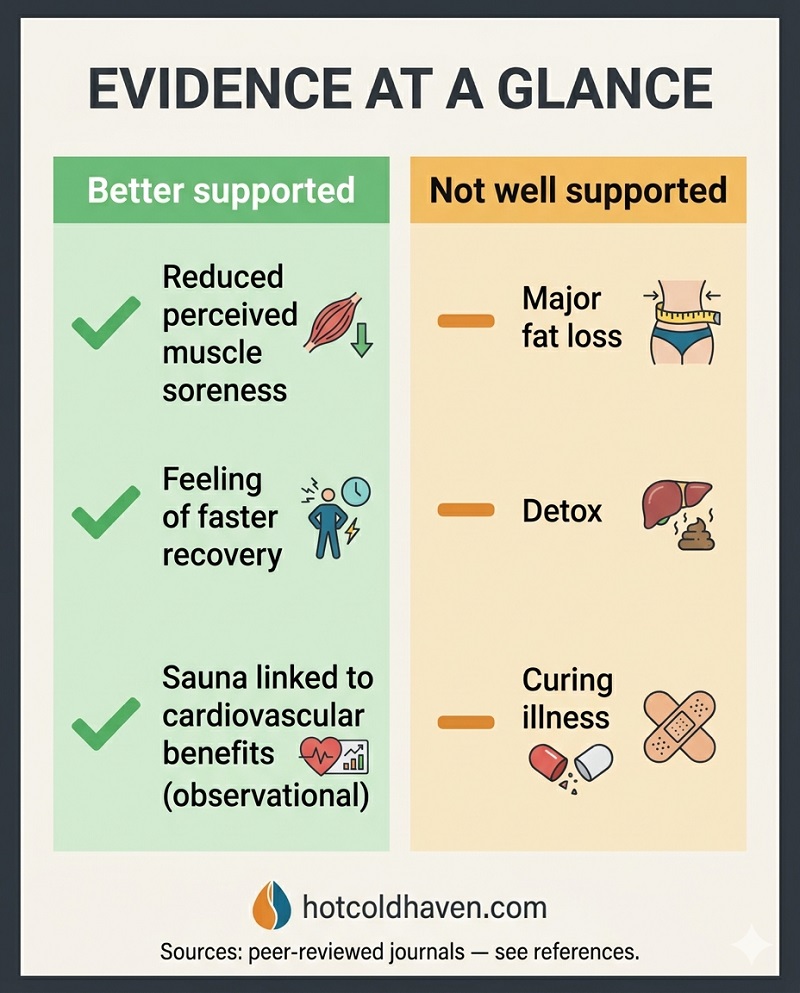
Honest summary up front: the strongest, most consistent benefits are for perceived recovery and how refreshed you feel, plus heat’s well-studied links to relaxation and cardiovascular health. The claims around dramatic fat loss or “detox” are not well supported. Used sensibly, contrast therapy is a low-risk practice most healthy adults tolerate well — with a few important exceptions we’ll cover.
Key takeaways
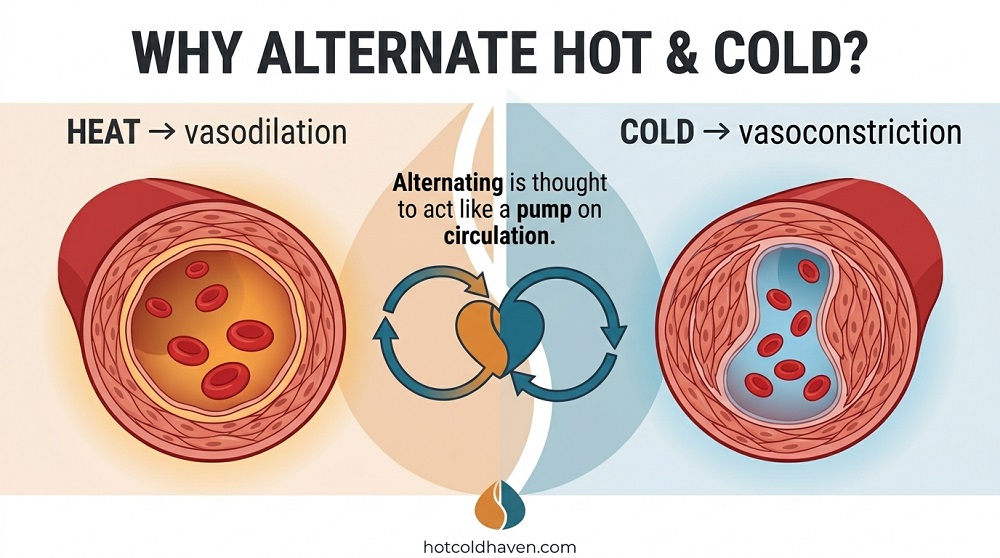
- Heat dilates blood vessels; cold constricts them. Alternating the two is thought to act like a pump on circulation.
- Best-supported benefit: reduced perceived muscle soreness and a feeling of faster recovery after exercise.2
- Athlete caveat: cold immediately after strength training may blunt muscle-building gains — separate the two if your goal is size.3
- Order & ending depend on your goal — covered below and in the right order for hot and cold.
What contrast therapy is
At its simplest, contrast therapy is cycling between a heat source (a sauna, hot bath, or shower) and a cold one (a cold plunge, cold-water immersion, or cold shower), usually for several rounds. In clinical and sports settings it’s often called contrast water therapy. The heat phase is longer and warming; the cold phase is shorter and bracing. Most people finish a session feeling alert and loose.
How it’s thought to work
The leading mechanism is vascular. Heat causes vasodilation — blood vessels widen and blood flow to the skin and muscles increases. Cold causes vasoconstriction — vessels narrow and blood shifts toward the core. Alternating the two is proposed to create a rhythmic “pumping” effect that may help move fluid and metabolic byproducts, though the precise contribution of this to recovery is still debated.1
Cold exposure also triggers a sharp rise in norepinephrine, which is linked to the alertness and mood lift many people report after a plunge. Heat exposure drives a relaxation and cardiovascular response that overlaps, in some ways, with moderate exercise.
What the evidence actually shows
Recovery and muscle soreness
This is the best-supported use. Reviews of contrast water therapy suggest it can modestly reduce perceived muscle soreness and improve the sense of recovery after intense exercise, comparable to other recovery methods. The effect is real but moderate, and part of it may be perceptual rather than purely physiological.2 For the practical application, see cold therapy for muscle recovery.
The athlete’s caveat
One well-cited finding is that cold-water immersion immediately after resistance training may blunt some of the muscle-building (hypertrophy) adaptations you’re training for.3 The takeaway isn’t “never use cold” — it’s timing. If your goal is strength or size, keep cold exposure away from your lifting sessions; use it on rest days or before training instead.
Heat, relaxation and cardiovascular health
Large observational studies — most prominently long-running Finnish cohort research — have associated frequent sauna bathing with better cardiovascular outcomes.4 Important nuance: these are associations, not proof that the sauna itself caused the benefit. Still, the relaxation and heart-rate response to heat is well documented, alongside a clear-eyed accounting of its risks.6 More in what the science says about saunas.
Sleep and mood
Many people use heat in the evening to wind down; the body cooling after you leave a warm sauna may support the natural temperature drop that precedes sleep. The research here is promising but smaller — we cover what’s known in how sauna improves sleep.
How to actually do it
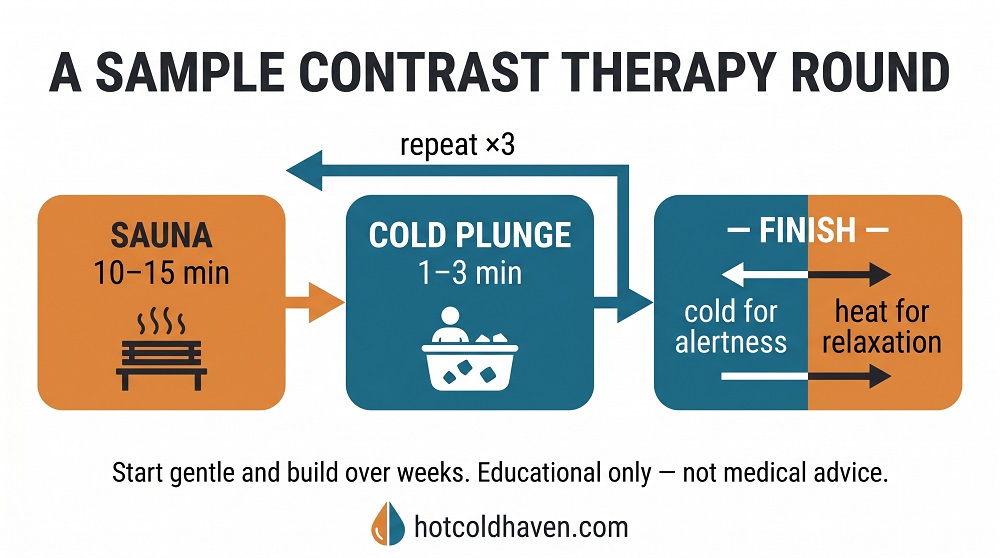
A common starting structure is several rounds of a longer warm phase followed by a shorter cold phase. Beginners often start gentle and build tolerance over weeks rather than chasing extremes on day one. The right ratios and total time depend on your goal — recovery, alertness, or relaxation — and we lay out specific structures in the ideal contrast therapy protocol and a full weekly plan in building a hot-cold routine.
Build a protocol for your goal
Answer three questions — recovery, sleep, or energy — and get a personalized hot-cold sequence you can save and print.
Open the Protocol Builder →Sauna or cold plunge first?
There’s no single right answer — it depends on what you want from the session. As a rule of thumb, ending on cold tends to leave you alert and is popular for daytime recovery, while ending on heat is more relaxing and often preferred before bed. The full reasoning, including how to sequence multiple rounds, is in whether to sauna or plunge first.
Who should be cautious
The same extremes that make contrast therapy effective also make it demanding on your body.
How it compares: Wim Hof & cryotherapy
Cold exposure shows up in other popular practices. The Wim Hof method pairs breathing techniques with cold; whole-body cryotherapy uses brief exposure to extremely cold air rather than water. Each has a different evidence base and risk profile5, which we break down in those guides.
Building your setup
Ready to do this at home? Start with our complete cold plunge buying guide and complete home sauna buying guide. To plan a dedicated space for both, see how to build a home recovery room.
Frequently asked questions
Is contrast therapy scientifically proven?
The strongest evidence supports modestly improved perceived recovery and reduced muscle soreness, plus heat’s well-studied relaxation and cardiovascular effects. Claims of major fat loss or detox are not well supported. It’s a low-risk practice for most healthy adults.
Should I end on hot or cold?
Ending on cold tends to leave you alert (good for daytime); ending on heat is more relaxing (often preferred before bed). See our full breakdown.
Will cold plunging hurt my muscle gains?
Cold-water immersion right after resistance training may blunt some hypertrophy adaptations. If building muscle is the goal, keep cold exposure away from your lifting sessions rather than skipping it entirely.
How often should I do contrast therapy?
Regular, moderate sessions tend to beat occasional extreme ones. Build tolerance gradually. A sensible weekly structure is in our routine guide.
Is it safe if I have high blood pressure?
Not without medical clearance. Both heat and cold meaningfully affect blood pressure and heart rate. Speak with your doctor before starting.
References
- Bieuzen F, Bleakley CM, Costello JT. Contrast Water Therapy and Exercise Induced Muscle Damage: A Systematic Review and Meta-Analysis. PLoS ONE. 2013;8(4):e62356. doi:10.1371/journal.pone.0062356
- Bleakley C, McDonough S, Gardner E, et al. Cold-water immersion (cryotherapy) for preventing and treating muscle soreness after exercise. Cochrane Database of Systematic Reviews. 2012;(2):CD008262. doi:10.1002/14651858.CD008262.pub2
- Roberts LA, Raastad T, Markworth JF, et al. Post-exercise cold water immersion attenuates acute anabolic signalling and long-term adaptations in muscle to strength training. The Journal of Physiology. 2015;593(18):4285–4301. doi:10.1113/JP270570
- Laukkanen T, Khan H, Zaccardi F, Laukkanen JA. Association Between Sauna Bathing and Fatal Cardiovascular and All-Cause Mortality Events. JAMA Internal Medicine. 2015;175(4):542–548. doi:10.1001/jamainternmed.2014.8187
- Costello JT, Baker PRA, Minett GM, et al. Whole-body cryotherapy for preventing and treating muscle soreness after exercise in adults. Cochrane Database of Systematic Reviews. 2015;(9):CD010789. doi:10.1002/14651858.CD010789.pub2
- Hannuksela ML, Ellahham S. Benefits and risks of sauna bathing. The American Journal of Medicine. 2001;110(2):118–126. doi:10.1016/s0002-9343(00)00671-9
Links open on the publishers’ sites. Studies on cold and heat exposure vary in quality and sample size; this guide reflects the balance of current evidence, not certainty.