Contrast Therapy Protocol: How to Build Your Routine
If you’ve read our contrast therapy guide, this is the practical how-to: building a protocol that fits your goal. (Or skip the math and use our Protocol Builder.)
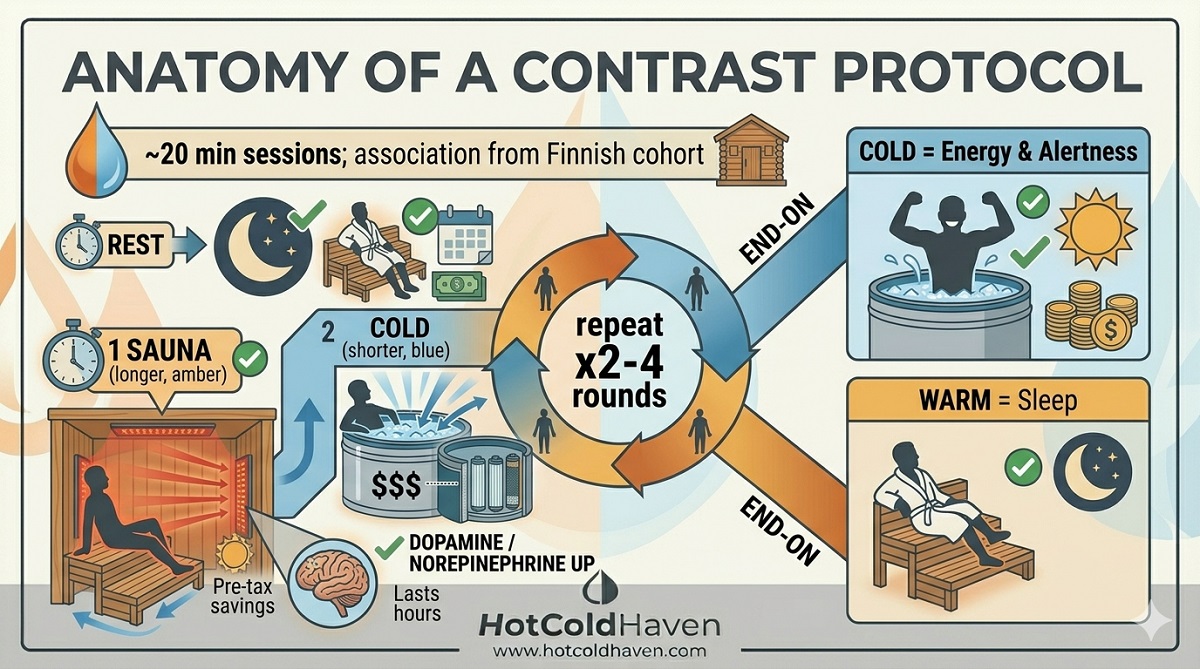
The building blocks
- Rounds: 2 (beginner) to 3–4 (experienced).
- Heat: longer — e.g. 10–20 minutes in the sauna per round (see temperature).
- Cold: shorter — e.g. 30 seconds to ~3 minutes (see how cold / how long).
- Rest: a minute or two between rounds to breathe and settle.
- End on: cold for energy; warm/neutral for sleep.
Sample protocols by goal
| Goal | Protocol | End on |
|---|---|---|
| Recovery | 3 rounds: 12–15 min sauna → 1–2 min cold | Cold |
| Energy | 2–3 rounds: 10–15 min sauna → 1 min cold | Cold |
| Sleep | 2 rounds: 12–15 min sauna → short, mild cold | Warm/neutral, 1–2 h before bed |
What you end on matters most
End on cold for an alert, energized finish; end warm/neutral when winding down for sleep. And if building muscle is the goal, keep heavy cold away from strength sessions — see cold therapy & recovery.
Who should be cautious
Contrast therapy is demanding on the cardiovascular system. Talk to your doctor before starting — and take extra care or avoid it — if any of these apply:
| Seek medical advice / take care if you have… | Why it matters |
|---|---|
| Heart disease or a heart-rhythm condition | Rapid hot-to-cold swings sharply change heart rate and blood pressure |
| High or low blood pressure | Heat and cold shift blood pressure in opposite directions |
| Pregnancy | Heat exposure in particular needs medical guidance |
| Raynaud’s or a circulatory disorder | Cold can trigger or worsen episodes |
| Recent surgery, an open wound, or acute illness | Heat and cold can interfere with healing or strain the body |
FAQ
What is a contrast therapy protocol?
A structured routine alternating heat (sauna) and cold (plunge) in rounds. A typical protocol sets the number of rounds, how long you spend hot and cold, the rest between, and — most importantly — whether you finish hot or cold based on your goal.
What’s a good contrast therapy ratio?
A common approach is longer heat and shorter cold — for example several minutes in the sauna to under a minute or two in the cold, repeated for 2–4 rounds. There’s no single ‘correct’ ratio; comfort and your goal matter more.
Should I end on hot or cold?
End on cold for energy and alertness; end warm or neutral if you’re winding down for sleep. If muscle growth is your goal, avoid heavy cold right after strength training.
How many rounds of contrast should I do?
Beginners often start with 2 rounds; 3–4 is common for experienced users. Keep heat longer, cold shorter, with brief rests — or use our protocol builder to generate a routine for your goal and level.
Sources
- Bieuzen, Bleakley & Costello (2013), PLoS ONE — contrast water therapy & recovery. doi:10.1371/journal.pone.0062356
- Roberts et al. (2015), J Physiol — post-exercise cold immersion & training adaptation. doi:10.1113/JP270570
Educational only. Codes and conditions vary — confirm locally and consult a licensed professional.