Sauna for Sleep: Does It Work, and How to Time It
Heat and sleep have a real physiological link. Here’s how to use a sauna to wind down — and what to avoid.
Why warming helps you sleep
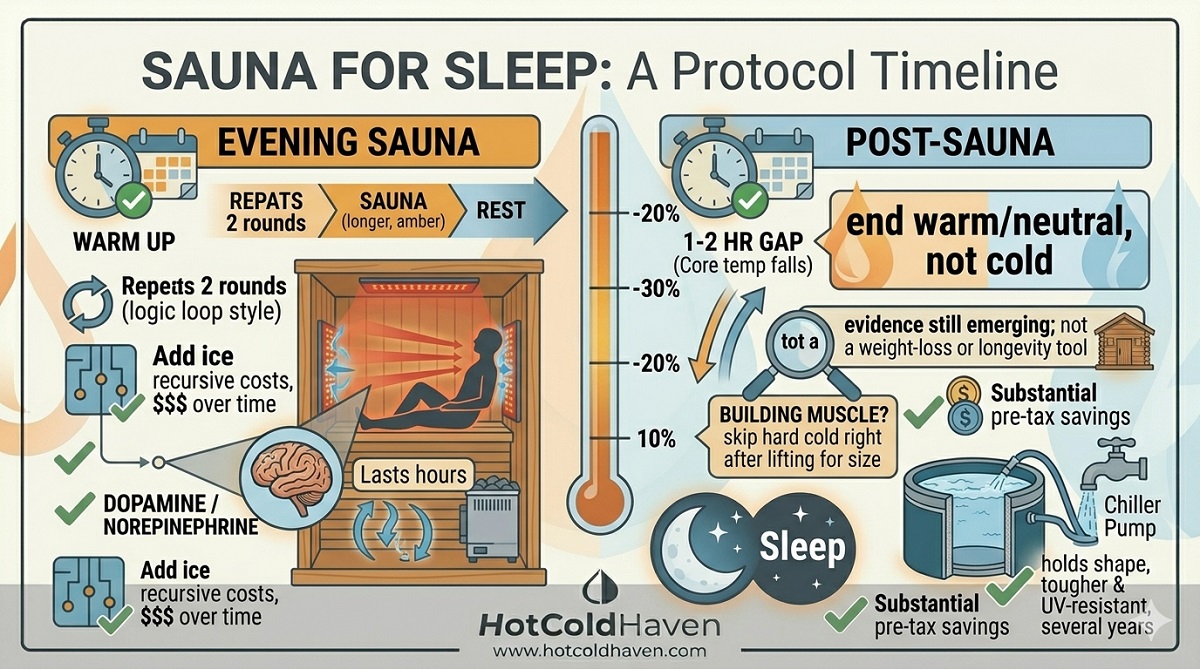
Falling asleep is tied to a drop in core body temperature. Warming your body in a sauna and then cooling afterward amplifies that drop, helping signal sleep. This mirrors well-studied research on warm baths 1–2 hours before bed, which improved how quickly people fell asleep.
How to do it
- Timing: finish 1–2 hours before bed, not immediately before.
- Intensity: a comfortable 15–20 minutes at a relaxing temperature — not a maximal session.
- Finish warm/neutral: skip the cold plunge in the evening, or keep any cold very brief and mild — intense cold is alerting.
- Wind down: dim lights, hydrate, and let the cool-down do its work.
What to avoid
Don’t end a bedtime routine on intense cold — it raises heart rate and alertness, the opposite of what you want. And don’t sauna right before bed, since you may still be too warm to drop off.
What the research suggests
The clearest evidence comes from studies of warm-water bathing before bed: a review found that passively warming the body 1–2 hours before sleep helped people fall asleep faster and improved sleep quality, by accelerating the natural evening drop in core temperature. A sauna works through the same thermoregulatory mechanism, and regular sauna use is also associated with relaxation and lower stress — both helpful for sleep. Direct sauna-and-sleep trials are still limited, so treat this as well-reasoned and widely reported rather than definitively proven.
Build a wind-down ritual
Get the most from it by pairing the timing with good sleep hygiene: dim the lights afterward, hydrate, and step away from bright screens as your body cools. Keep the session relaxing rather than maximal, and let the cool-down period be genuinely calm. The combination — gentle heat, a cooling window, then a dark, quiet room — is what nudges you toward sleep.
FAQ
Does using a sauna help you sleep?
Many people find an evening sauna helps them relax and fall asleep. The likely mechanism is the post-sauna drop in core body temperature, which is a natural sleep signal — similar to the well-studied effect of a warm bath before bed.
When should I sauna for better sleep?
Finish 1–2 hours before bed, not right before. That gives your core temperature time to fall, which helps signal sleep. Doing it too close to bedtime can leave you too warm or alert.
Should I cold plunge before bed?
Generally no. Intense cold is alerting and raises heart rate, which can make falling asleep harder. If you do contrast in the evening, finish warm or neutral rather than cold.
How hot and how long for sleep?
A comfortable, not maximal, session — around 15–20 minutes at a temperature you find relaxing. The goal is to warm gently and then let your body cool, not to push intensity.
Sources
- Haghayegh et al. (2019), Sleep Medicine Reviews — warm-water passive body heating before bed & sleep onset. doi:10.1016/j.smrv.2019.04.008
- Laukkanen, Laukkanen & Kunutsor (2018), Mayo Clinic Proceedings — sauna & relaxation/sleep. review summary
Educational only. Codes and conditions vary — confirm locally and consult a licensed professional.