Sauna Room Requirements: Electrical, Ventilation, Insulation & More
Whether you’re framing a custom room or placing a pre-built kit, a sauna has to satisfy a handful of requirements to be safe, efficient and durable. Get the electrical and the vapor barrier right and everything else follows. (Sizing the heater itself is covered in our heater sizing guide.)
Electrical
This is the make-or-break item. The setup depends on heater type and power:
| Sauna type | Typical power | Circuit |
|---|---|---|
| Infrared (1–2 person) | Under ~1.8 kW | Dedicated 120V, 15–20A |
| Small traditional | Under ~2 kW | Dedicated 120V (limited; rooms under ~100 cu ft) |
| Traditional 3–9 kW | 3–9 kW | Hardwired 240V, breaker + wire sized to the heater |
- Dedicated circuit, always — sharing with other loads risks nuisance trips and fire.
- Correct wire gauge & breaker — matched to the heater’s amperage; undersized wire is a fire hazard and voids warranties. Long 240V runs may need a heavier gauge to limit voltage drop.
- GFCI protection — strongly recommended (and often required) for outdoor saunas and wet/bathroom-adjacent locations; 240V circuits use a 2-pole GFCI breaker.
- No extension cords, ever, on a heater load.
- Hire a licensed electrician for the final connection — even if you run your own conduit.
Insulation & vapor barrier
Heat and humidity make this critical:
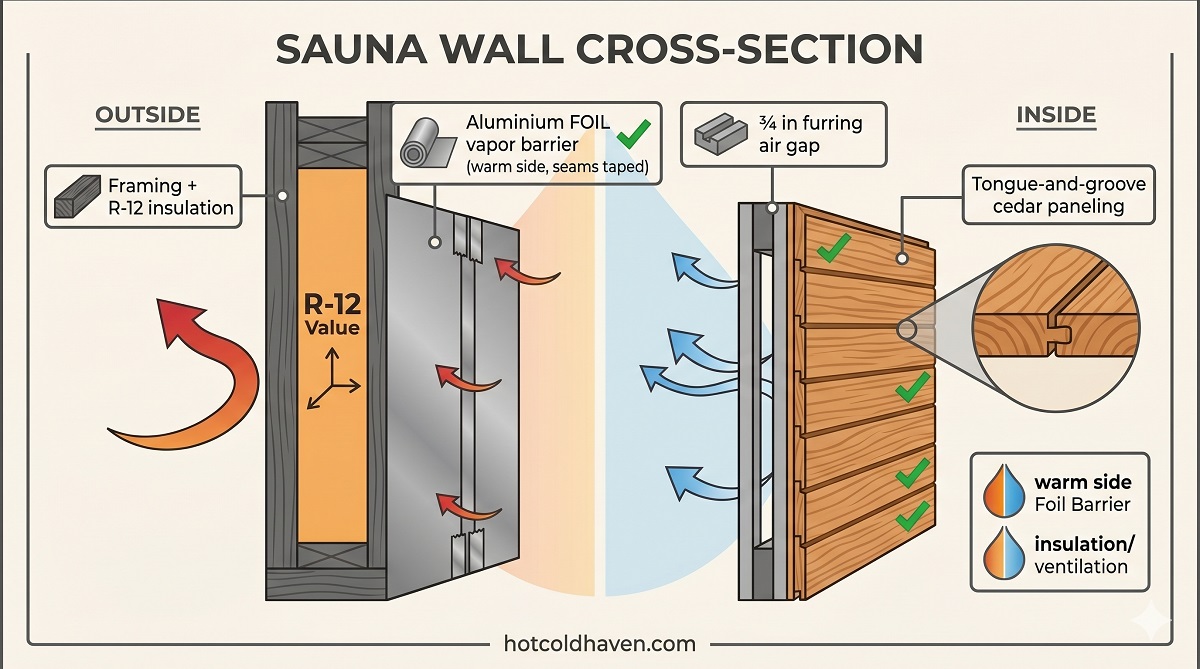
- Insulation: at least R-12 in walls and ceiling (more in the ceiling is better, since heat rises).
- Foil vapor barrier: aluminium foil on the warm side of walls and ceiling — not the floor. Overlap seams 2–3″ and seal with foil tape; seal every wire, box and vent penetration. Avoid polyethylene plastic — it deteriorates at sauna temperatures.
- Air gap: furring strips over the barrier create a ~¾” gap behind the paneling for radiant reflection and drying.
Ventilation
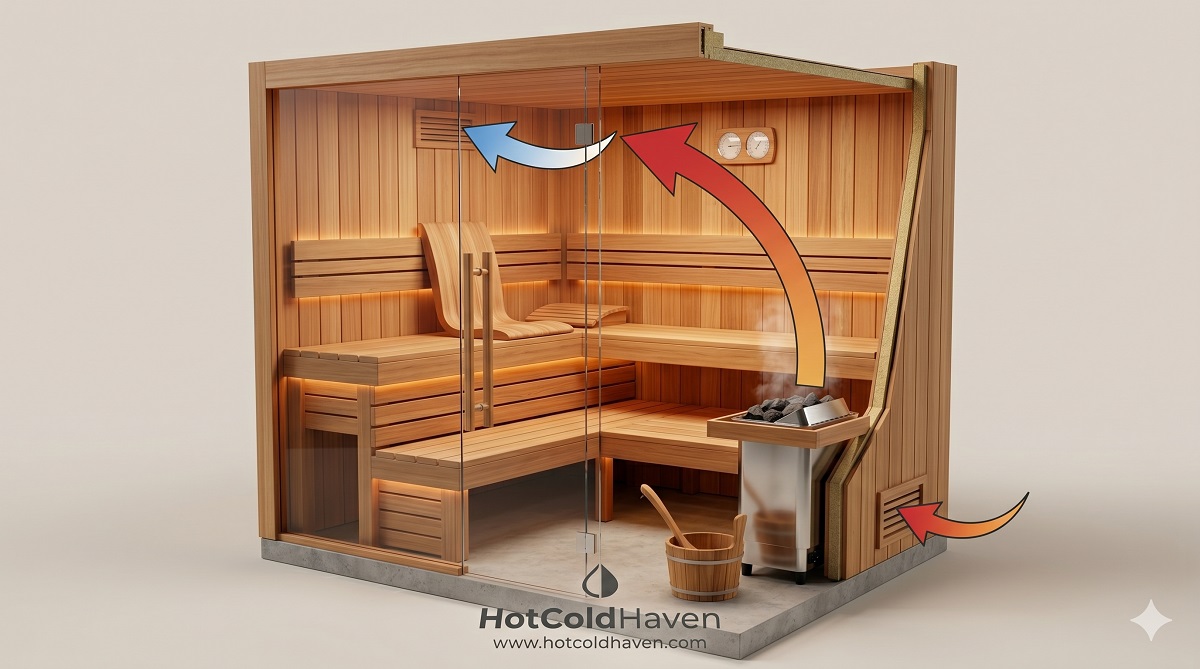
A sauna needs airflow: a low fresh-air intake near/under the heater and a high exhaust on the opposite wall, 4–6″ below the ceiling, both with adjustable dampers. Good ventilation keeps oxygen up, distributes heat, and lets humid air escape so the structure stays dry.
Dimensions, materials & finishes
- Ceiling height: 6.5–7 ft. Lower ceilings reduce the volume to heat and keep bathers in the hottest zone.
- Interior: tongue-and-groove Western red cedar, Nordic spruce or aspen — woods that handle heat and resist warping.
- Benches: clear-grade cedar or aspen with no exposed metal fasteners on sitting surfaces.
- Door: pre-hung tempered glass or solid wood, at least 24″ wide.
- Lighting: a vapor-proof fixture rated for high heat (warm white); never standard fixtures.
- Floor: non-combustible and water-resistant — tile or sealed concrete. A floor drain is optional; most home saunas need no plumbing. Wood-burning stoves need a non-combustible pad and a flue.
FAQ
Does a sauna need a dedicated electrical circuit?
Yes. Every electric sauna heater needs its own dedicated circuit, sized to the heater. Heaters of 3 kW and up require a hardwired 240V circuit; small infrared and sub-2 kW heaters can use a dedicated 120V circuit. Never use an extension cord.
Do I need a vapor barrier in a sauna?
Yes — a foil (aluminium) vapor barrier on the warm side of the walls and ceiling, with seams overlapped and foil-taped and all penetrations sealed. Don’t use polyethylene plastic; it degrades at sauna temperatures.
Does a sauna need ventilation?
Yes. A low fresh-air intake near the heater and a high exhaust on the opposite wall (with operable dampers) keep air fresh and protect the structure from trapped humidity.
Do saunas need plumbing or a drain?
Most residential saunas need no plumbing. A floor drain is a nice-to-have for easy cleaning but isn’t required. Electricity and ventilation are the real essentials.
Sources
- Haven of Heat — Sauna electrical & plumbing requirements. havenofheat.com
- Haven of Heat — Sauna insulation guide (R-values, foil vapor barrier, air gap). havenofheat.com
- Sun Home Saunas — Electrical requirements for a home sauna. sunhomesaunas.com
Educational only. Codes and conditions vary — confirm locally and consult a licensed professional.