Infrared vs Traditional Sauna: Which Is Right for You?
Both make you sweat and both have devoted fans — they just get there differently. Here’s how they compare so you can match one to the experience you want. For specific models, see best infrared saunas and the home sauna buying guide.
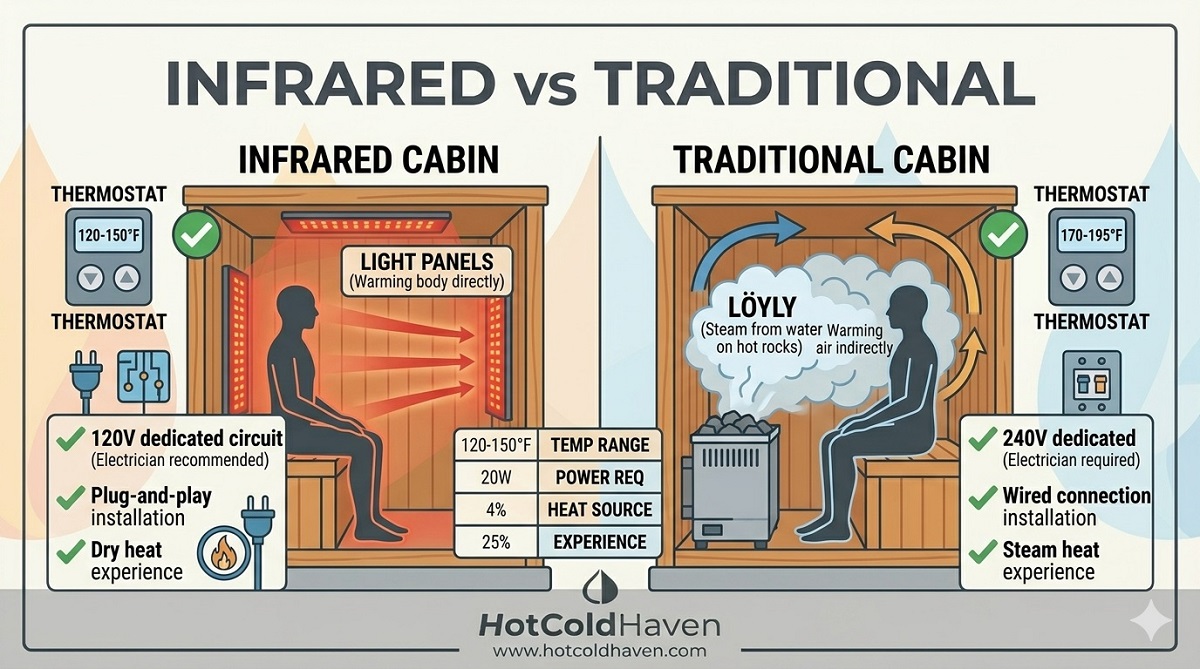
| Traditional (Finnish) | Infrared | |
|---|---|---|
| How it heats | Heats the air + rocks; air heats you | Light panels warm your body directly |
| Temperature | 170–195°F | 120–150°F |
| Humidity / löyly | Yes — water on rocks for steam | Dry heat, no steam |
| Heat-up time | 20–40 min | 10–15 min |
| Electrical | 240V hardwired (3 kW+) | Often 120V plug-in (1–2 person) |
| Install | More involved | Easiest — many assemble in an hour |
| Best for | The authentic, intense, social ritual | Gentler heat, lower cost, simplicity |
The experience
This is the real deciding factor. Traditional saunas deliver an enveloping, high-heat experience you can intensify with löyly (water on hot rocks) — the classic Finnish ritual. Infrared is a milder, dry heat many find more tolerable for longer sessions, with a sweat that starts at a lower air temperature.
Cost & install
Infrared 1–2 person cabins are generally cheaper to buy, plug into a standard outlet, and assemble quickly. Traditional saunas usually cost more, need a dedicated 240V circuit and proper room build, and the heater may be sold separately. Running costs for both land around $10–$30/month at typical use.
A note on health claims
Both promote sweating and relaxation. Much of the research associating sauna use with cardiovascular and recovery benefits comes from traditional Finnish sauna studies; infrared has a smaller (though growing) evidence base, and some infrared marketing (e.g. “detox”) outpaces the science. We cover the evidence cautiously in our contrast therapy guide. As always, this is educational, not medical advice.
FAQ
What’s the difference between infrared and traditional saunas?
A traditional sauna heats the air (and rocks) to 170–195°F so the hot air warms you; an infrared sauna uses infrared panels to warm your body directly at a gentler 120–150°F. Traditional gives the classic intense, humid löyly experience; infrared is milder and plug-and-play.
Which is better, infrared or traditional?
Neither is universally better. Choose traditional for the authentic high-heat, steam-and-löyly ritual; choose infrared for a gentler, lower-cost, easier-to-install sweat at lower temperatures. It comes down to the experience you want.
Do infrared saunas need special wiring?
Most 1–2 person infrared saunas plug into a standard 120V outlet (on a dedicated circuit). Traditional electric heaters of 3 kW and up need a hardwired 240V circuit.
Which heats up faster?
Infrared saunas are usable in 10–15 minutes since they warm you directly. Traditional saunas take 20–40 minutes to bring the whole room up to temperature.
Sources
- Finnish Sauna Builders — Infrared vs traditional heating & temperatures. finnishsaunabuilders.com
- The Sauna Place — Infrared vs traditional cabin temperatures. saunaplace.com
- Sun Home Saunas — Sauna electrical requirements (120V infrared vs 240V traditional). sunhomesaunas.com
Educational only. Codes and conditions vary — confirm locally and consult a licensed professional.