Sauna Benefits: What the Research Actually Shows
Sauna bathing is one of the better-studied wellness habits, largely thanks to a long-running Finnish cohort. Here’s what the evidence actually shows — and where to stay cautious.
Cardiovascular health
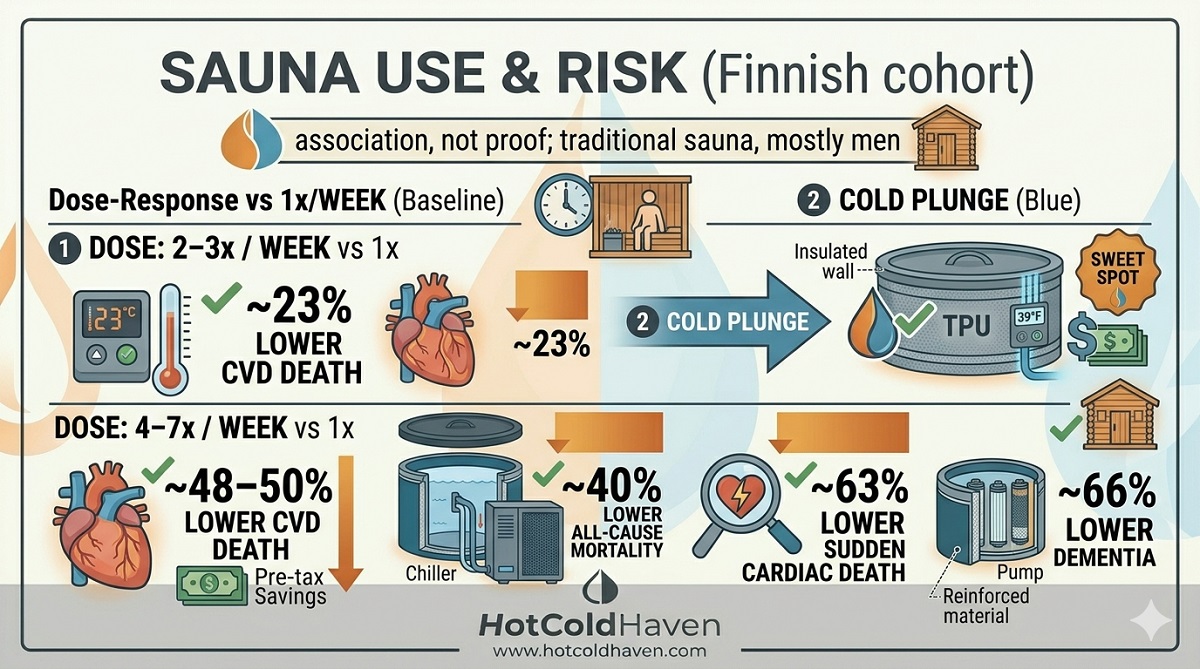
This is the strongest area. In the Kuopio cohort (2,300+ middle-aged Finnish men), compared with once a week, using a sauna 2–3×/week was linked with ~23% lower fatal cardiovascular disease, and 4–7×/week with roughly 48–50% lower — and about 40% lower all-cause mortality. A sauna session raises heart rate toward levels seen in moderate exercise and is associated with better vascular function and a ~47% lower risk of developing hypertension in frequent users.
Brain & dementia
Later analyses found frequent sauna use (4–7×/week) associated with roughly 66% lower dementia and ~65% lower Alzheimer’s risk versus once a week, even after adjusting for many factors. Proposed mechanisms include better vascular health and heat-shock proteins, but causation isn’t established.
Recovery, relaxation & more
Beyond the cohort data, sauna use is widely reported to ease muscle tension, aid relaxation and sleep, and pair well with cold for contrast therapy. These effects are real for many people, though the formal evidence is lighter than the cardiovascular findings.
The honest caveats
- Most data is observational — frequent sauna users may be healthier in other ways.
- The strongest studies are on traditional Finnish saunas and largely men; infrared has a smaller evidence base.
- Benefits track with frequency and session length (see how often to sauna) — they’re not a quick fix.
FAQ
What are the proven benefits of sauna use?
The strongest evidence is cardiovascular: large Finnish cohort studies link frequent sauna bathing with lower risks of fatal heart disease and all-cause mortality, plus lower blood pressure. Regular use is also associated with reduced dementia risk and is widely reported to aid relaxation and recovery. Most of this is observational, not proof of cause.
How does a sauna benefit the heart?
A hot sauna raises heart rate and cardiac output much like moderate exercise, and over time is associated with improved blood-vessel function and lower blood pressure. In Finnish studies, frequent users had markedly lower cardiovascular mortality than once-a-week users.
Does sauna use reduce dementia risk?
Observational Finnish research found men who used a sauna 4–7 times a week had roughly two-thirds lower dementia and Alzheimer’s risk than once-a-week users. It’s an association, not proof, but a striking one.
Are sauna benefits the same for infrared saunas?
Most of the strongest research is on traditional Finnish saunas, not infrared. Infrared has a smaller (though growing) evidence base, so apply the headline findings to traditional saunas with that caveat.
Sources
- Laukkanen et al. (2015), JAMA Internal Medicine — sauna use & cardiovascular/all-cause mortality. doi:10.1001/jamainternmed.2014.8187
- Laukkanen, Laukkanen & Kunutsor (2018), Mayo Clinic Proceedings — “Cardiovascular and other health benefits of sauna bathing.” review summary
- Laukkanen et al. (2017), Age and Ageing — sauna bathing & dementia/Alzheimer’s risk. PMID 27932366
Educational only. Codes and conditions vary — confirm locally and consult a licensed professional.