Cold Plunge Benefits: Evidence vs Hype
Cold plunging has exploded in popularity, with claims to match. Here’s what the science genuinely supports, separated from the hype.
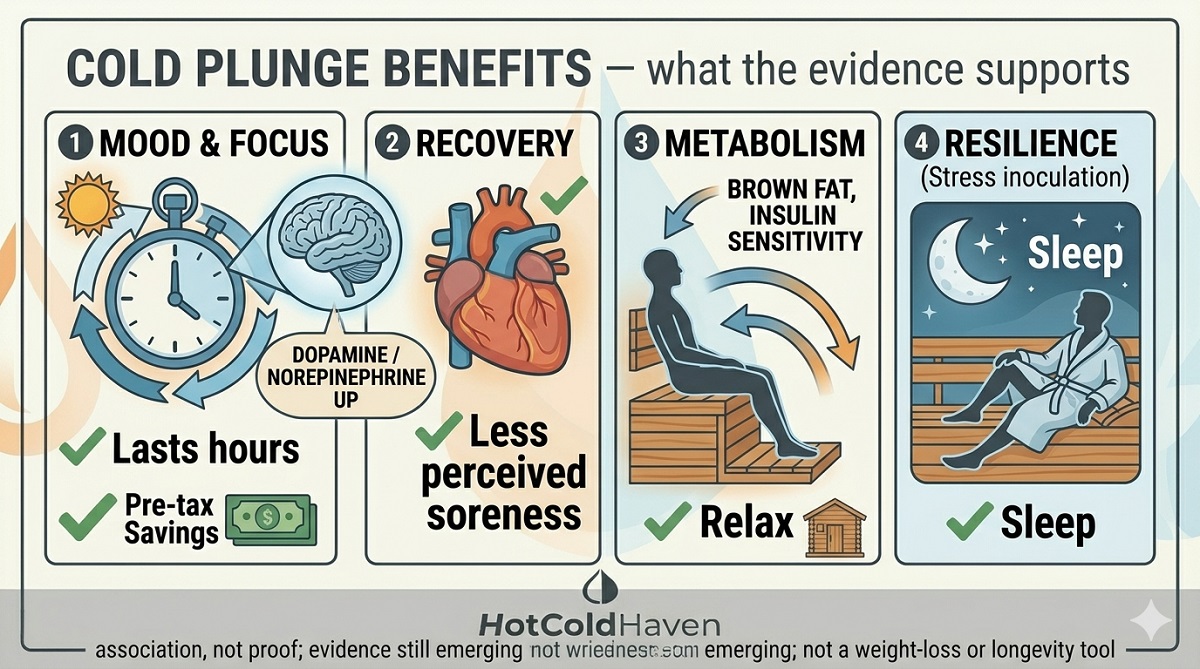
Mood, focus & energy (the standout)
This is the most striking effect. Cold immersion triggers a large release of dopamine (one study reported a ~2.5× increase) and norepinephrine (up several-fold), producing a sustained lift in mood, focus and energy that can last hours — without the crash of a stimulant. Early work on cold-water swimmers is encouraging for mood and well-being, though clinical evidence remains limited.
Recovery & soreness
Cold immersion reliably reduces perceived muscle soreness and feels restorative after hard efforts (Bieuzen et al. 2013). One important nuance: heavy cold right after strength training may blunt muscle-building adaptations (Roberts et al. 2015), so if hypertrophy is your goal, separate cold from lifting — see cold therapy & recovery.
Metabolism & brown fat
Cold activates brown adipose tissue, which burns energy to generate heat, and is linked with improved insulin sensitivity; one researcher found measurable changes from about 11 minutes of cold immersion per week. Useful for metabolic health — but not a meaningful weight-loss strategy by itself.
Resilience
Deliberately facing a tolerable stressor can build stress resilience and a sense of accomplishment — a commonly reported psychological benefit, even if harder to quantify.
The honest limits
- Much evidence is early or on small/specific groups (e.g. winter swimmers).
- Cold plunging doesn’t extend lifespan per current research.
- The mood effects are real but the clinical (depression/anxiety) evidence is still limited.
FAQ
What are the benefits of cold plunging?
The best-supported effects are a marked, lasting mood and alertness boost (driven by dopamine and norepinephrine) and reduced perceived muscle soreness. Cold exposure is also linked with brown-fat activation and better insulin sensitivity. Much of the evidence is still emerging.
Does cold plunging boost mood?
Yes — cold immersion produces a large, sustained rise in dopamine and norepinephrine, which many people experience as hours of improved mood, focus and energy. Early studies on cold-water swimmers are promising, though the clinical evidence is still limited.
Does cold plunging help muscle recovery?
It can reduce perceived soreness and feels restorative. But heavy cold immersion right after strength training may blunt some muscle-building adaptations, so time it away from lifting if growth is the goal.
Does cold plunging help you lose weight or live longer?
Cold exposure activates calorie-burning brown fat and may improve insulin sensitivity, but it isn’t a meaningful weight-loss tool on its own, and current research does not show it extends lifespan.
Sources
- Bieuzen, Bleakley & Costello (2013), PLoS ONE — contrast water therapy & recovery. doi:10.1371/journal.pone.0062356
- Roberts et al. (2015), J Physiol — post-exercise cold immersion & training adaptation. doi:10.1113/JP270570
- Søberg et al. / Huberman Lab — deliberate cold exposure: dopamine, norepinephrine & brown fat (~11 min/week). hubermanlab.com
Educational only. Codes and conditions vary — confirm locally and consult a licensed professional.