Cold Plunge Cost: What You’ll Really Pay (2026)
Cold plunge prices vary even more than saunas, mostly depending on whether there’s a chiller. Here’s the full breakdown.
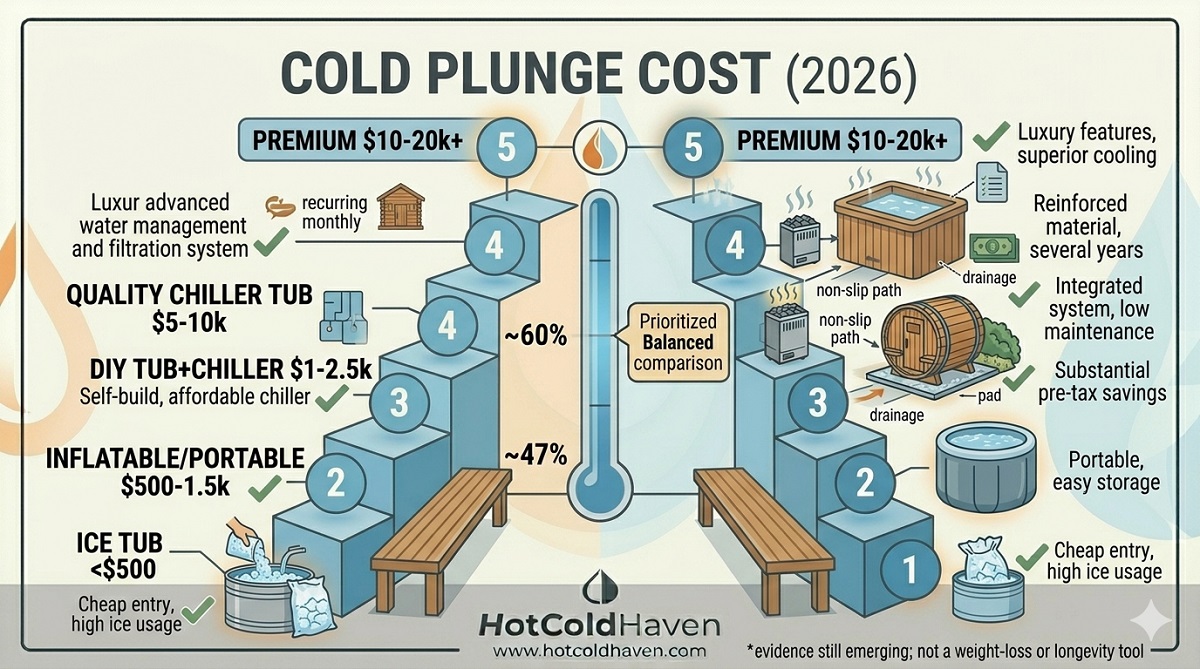
Price by type
| Type | Typical price | Notes |
|---|---|---|
| Basic ice tub | under $150–$500 | No chiller; you add ice |
| Inflatable / portable | $500–$1,500 | Often chiller-compatible |
| DIY tub + chiller | $1,000–$2,500 | Best value for a real setup |
| Quality chiller-equipped tub | $5,000–$10,000 | The mainstream “finished” option |
| Premium / built-in | $10,000–$20,000+ | High-end materials & integration |
Running & hidden costs
- Electricity: ~$10–$45/month for a chiller (see running costs), vs $200+/month for daily ice.
- Chiller (if separate): ~$500–$3,000 for a DIY build.
- Electrical/GFCI near the unit, and a solid level base (see placement).
- Water care: filters, sanitizer (see water treatment).
Payback vs. ice: a chiller’s higher upfront cost is offset by its low running cost. If you’d otherwise spend $150–$250+ a month on ice for daily plunging, a chiller-equipped setup often covers the difference within roughly a year of regular use — the calculator below shows the crossover for your own numbers.
What drives the price
The biggest factor is the chiller — its presence, horsepower, and efficiency. After that: insulation and build quality (better insulation lowers running cost), materials (acrylic/fiberglass vs. inflatable PVC), integrated filtration and ozone/UV sanitation, and brand. A bare tub plus a separate chiller is almost always cheaper than an all-in-one finished unit — the trade is assembly and a less polished look.
Where to save without regretting it
Smart savings: start with an inflatable or DIY setup to confirm you’ll stick with cold therapy, choose a right-sized chiller rather than the biggest one (HP is speed, not minimum temperature), and skip premium cosmetic extras. Where not to cut: insulation and a fitted cover, which pay for themselves in lower running costs.
Budget for the running costs too
The sticker price isn’t the whole cost. Factor in $10–$45/month of electricity for a chiller, plus filters and water care. It’s still far cheaper than buying ice for daily use — but worth including so there are no surprises.
FAQ
How much does a cold plunge cost?
Anywhere from under $150 for a basic ice tub to $20,000+ for premium built-in units. Typical: inflatable/portable $500–$1,500; quality chiller-equipped tubs $5,000–$10,000; premium $10,000–$20,000+; a DIY build $1,000–$2,500.
What’s the cheapest cold plunge option?
A simple insulated tub or stock tank with ice is the cheapest to buy (under $150–$500), but ice gets expensive with regular use. A DIY tub-plus-chiller is the cheapest convenient long-term setup.
How much does a cold plunge cost to run?
About $10–$45 a month in electricity for a chiller with daily use — far cheaper than buying ice, which can exceed $200/month for daily plunges. A fitted cover keeps running costs down.
Is a cold plunge cheaper than an ice bath long-term?
For regular use, yes. The chiller’s upfront cost is offset by low running cost, while ongoing ice purchases for daily ice baths add up to far more over a year.
Sources
- HotColdHaven — cold plunge running-cost analysis (chiller vs ice). internal
- Peak Primal Wellness — home cold plunge cost & running breakdown. peakprimalwellness.com
Educational only. Codes and conditions vary — confirm locally and consult a licensed professional.