Cold Therapy for Muscle Recovery: Timing Is Everything
Cold for recovery is more popular than ever, and mostly helpful — but the “when” matters as much as the “whether.” Here’s how to use it without sabotaging your training.
What cold does for recovery
Cold water immersion constricts blood vessels and reduces perceived muscle soreness (DOMS), and contrast therapy is reasonably supported for recovery (Bieuzen et al. 2013). Many athletes also value the mental “reset” and reduced fatigue between sessions.
The strength-training caveat
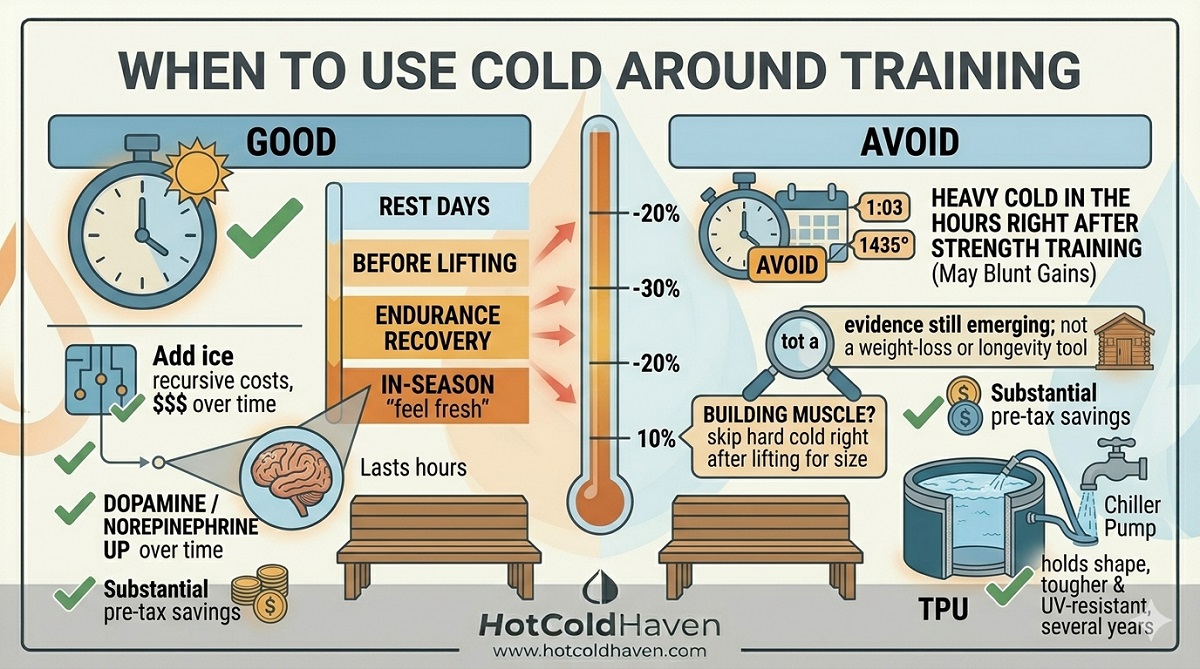
Here’s the part to get right: a well-known study found that regular post-exercise cold immersion blunted gains in muscle mass and strength compared with active recovery (Roberts et al. 2015). The likely reason is that cold dampens the very inflammatory signaling that drives muscle adaptation. So if hypertrophy or strength is your goal, don’t plunge right after lifting.
How to time it
- Building muscle/strength? Cold on rest days, before lifting, or several hours after — not immediately post-session.
- Endurance or in-season recovery? Cold’s recovery benefits usually win; use it when you need to feel fresh for the next session.
- Just want to feel good? Plunge whenever it suits — the adaptation concern is specific to maximizing strength/size.
Practical settings
Around 50–59°F for a few minutes is plenty. Colder isn’t necessary for recovery.
Don’t forget the sauna side
If cold after lifting is off the table for muscle-building, heat is a useful alternative. Sauna use increases blood flow and is widely used for relaxation and easing stiffness — and, unlike cold immersion, it isn’t thought to blunt strength or hypertrophy adaptations. Some research even links heat exposure with reduced muscle atrophy during disuse. So on a heavy strength day, finishing warm (sauna) rather than cold can give you a recovery ritual without the trade-off (see sauna benefits).
A simple decision rule
Boil it down to one question: is this session about building maximum strength or size? If yes, keep heavy cold away from it — plunge on a rest day or end warm. If it’s endurance work, a tough metcon, or you simply need to feel fresh for tomorrow, cold’s recovery and mood benefits usually win. When in doubt, separate the cold from the lifting by several hours.
FAQ
Does cold therapy help muscle recovery?
It reliably reduces perceived soreness and feels restorative after hard sessions. But the picture is nuanced: heavy cold immersion right after strength training may blunt some muscle-building and strength adaptations.
Should I cold plunge after lifting weights?
If your goal is muscle growth or strength, avoid heavy cold immersion in the hours right after a lifting session — research suggests it can blunt adaptation. Do cold on rest days, before lifting, or well after.
Is cold therapy good for endurance athletes?
Generally yes — for endurance training, competition recovery, or when you just need to feel fresh between sessions, cold immersion’s recovery benefits usually outweigh the adaptation concern that applies to strength training.
How cold and how long for recovery?
Typical recovery protocols use roughly 50–59°F water for a few minutes. Colder isn’t necessary; consistency and timing relative to your training matter more.
Sources
- Roberts et al. (2015), J Physiol — post-exercise cold water immersion attenuates strength/hypertrophy adaptation. doi:10.1113/JP270570
- Bieuzen, Bleakley & Costello (2013), PLoS ONE — contrast water therapy & recovery. doi:10.1371/journal.pone.0062356
Educational only. Codes and conditions vary — confirm locally and consult a licensed professional.