Cold Plunge Water Treatment: How to Keep Water Clean
A cold plunge is a small body of warm-bodied water used at high “bather load,” so it needs real maintenance. The good news: a simple routine keeps it crystal clear. Here are your options and how to combine them. (For the hardware that circulates and chills, see the chiller guide.)
1. Filtration & circulation (the foundation)
Filtration removes the particles sanitizers can’t. Run a cartridge filter several hours a day (4–8 is common), rinse it weekly, and replace cartridges every 3–4 weeks with heavy use. Continuous circulation during use prevents dead zones where bacteria settle.
2. Sanitizer options
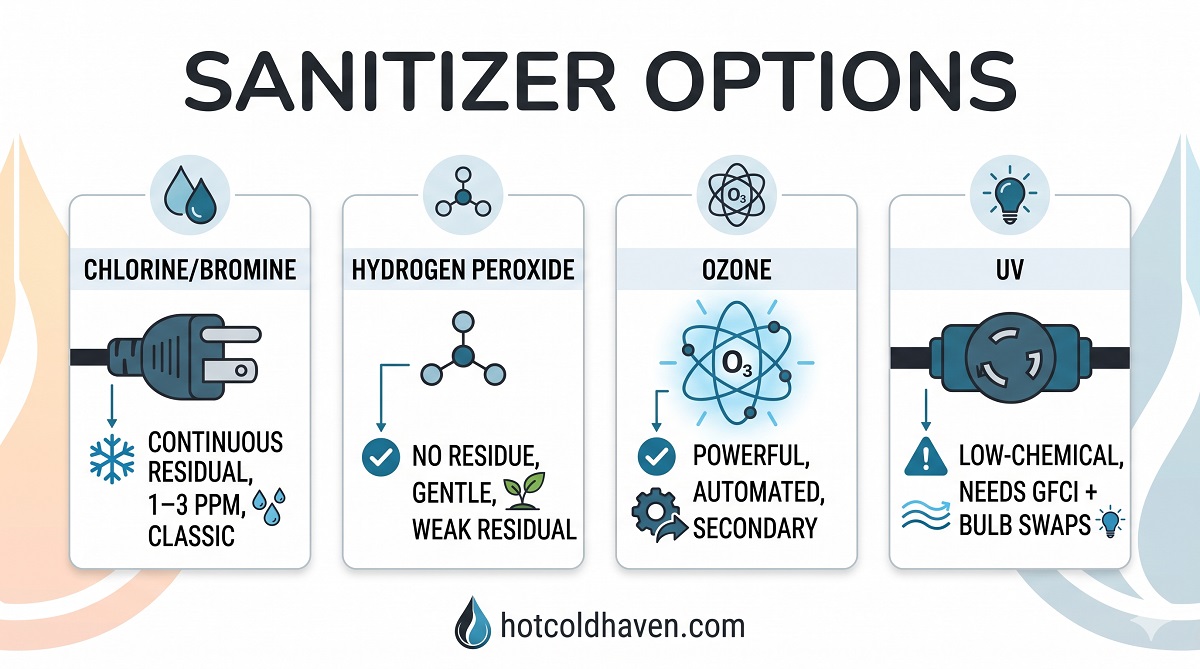
- Chlorine / bromine — the proven route, kept low (1–3 ppm). They hold a continuous residual that protects the whole volume. Bromine is more stable in cold water and gentler on skin; chlorine has the familiar smell.
- Food-grade hydrogen peroxide — popular DIY choice; breaks down into water and oxygen with no residue and is easy on skin. The catch: it doesn’t hold a strong residual, so pair it with ozone and test often.
- Ozone — an automated generator that powerfully oxidizes organics and extends water life. Excellent as a secondary system, but not a stand-alone residual.
- UV — inactivates microbes as water passes the lamp, cutting chemical reliance; needs a GFCI outlet and occasional bulb replacement. Also a secondary system.
3. Water changes & shock
| Setup | Typical change frequency |
|---|---|
| Single user, indoor, filtered + sanitized | Every 2–4 weeks |
| Outdoor or multi-user | Every 1–2 weeks |
| Basic tub, no filter/sanitizer | Every few days |
Between full changes, shock weekly or bi-weekly to oxidize accumulated organics — a non-chlorine shock is ideal because it works fast and lets you plunge again within an hour or two. Change the water whenever it turns cloudy, smells musty, or the walls feel slippery (a sign of biofilm).
Hard water & saltwater options
Two situations worth planning for:
- Hard (high-mineral) water can scale up your chiller’s coil and plumbing over time, quietly reducing cooling efficiency. In a hard-water area, start with filtered or softened fill water, watch for scale on fittings, and descale per your chiller maker’s guidance — scale buildup is a leading cause of gradual cooling loss.
- Saltwater (mineral) systems use a low salt concentration with a generator to produce sanitizer, for a gentler feel and less hands-on dosing. They can work for cold plunges, but check compatibility first — salt is corrosive to some chiller components and metals, and not every manufacturer permits it. Confirm with the maker before converting.
Keep it simple: a weekly rhythm
- Run filtration daily; rinse the filter weekly.
- Test pH (7.2–7.6) and sanitizer 2–3× a week.
- Shower before plunging; keep a fitted cover on when idle.
- Shock weekly; change water on schedule.
- Avoid chlorine if your chiller maker warns against it — some components don’t tolerate it.
FAQ
How do I keep cold plunge water clean?
Combine three things: filtration (a cartridge filter run several hours daily), a sanitizer (chlorine/bromine, food-grade hydrogen peroxide, or an ozone/UV system), and regular partial or full water changes. Shower before plunging and cover the tub when idle.
How often should I change cold plunge water?
With good filtration and sanitation: roughly every 2–4 weeks for a single indoor user, 1–2 weeks for outdoor or multi-user tubs, and every few days for a basic setup with no filter. Change sooner if water turns cloudy, smells, or the walls feel slimy.
Can I use chlorine in a cold plunge?
Yes, at low levels (1–3 ppm), and bromine is a gentler, more cold-stable alternative. Both give a continuous protective residual. Many users prefer chlorine-free options for skin comfort, but those need careful management.
Is hydrogen peroxide enough on its own?
Food-grade hydrogen peroxide is popular because it leaves no residue, but it breaks down fast and struggles to hold a residual under variable use. It works best paired with continuous ozone and frequent testing — not as a sole sanitizer for shared tubs.
Sources
- Sun Home Saunas — Cold plunge filtration (ozone vs UV vs salt) & water change cadence. sunhomesaunas.com
- Sweat Decks — Hydrogen peroxide dosing & troubleshooting (biofilm, cloudiness). sweatdecks.com
- Plunge Chill — Water quality guide (residual vs secondary systems; CDC MAHC note). plungechill.com
Educational only. Codes and conditions vary — confirm locally and consult a licensed professional.