How Long Should You Cold Plunge?
Duration is where people most often overdo it. Here’s how long to actually stay in, by experience and temperature.
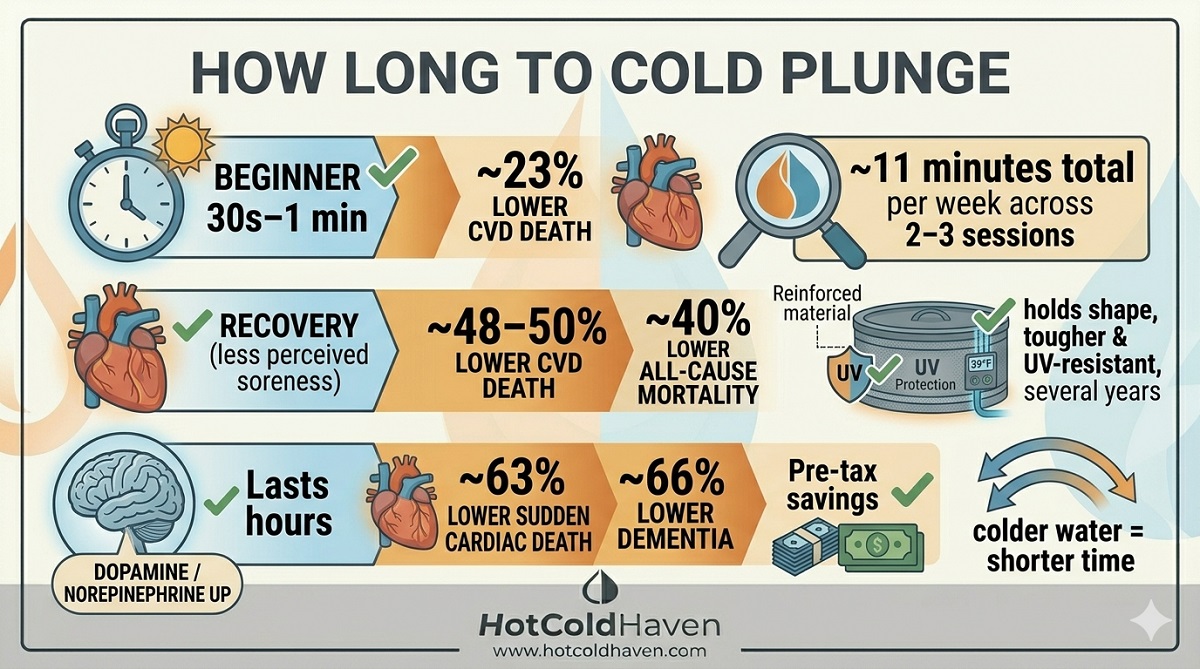
| Level | Per session | Notes |
|---|---|---|
| Beginner | 30 sec – 1 min | Focus on calm breathing; build slowly |
| Intermediate | 1 – 3 min | Comfortable, controlled |
| Advanced | 2 – 5 min | Colder water → stay toward the shorter end |
The ~11-minutes-a-week target
A frequently cited, research-linked guideline is about 11 minutes of total cold immersion per week, spread across 2–3 sessions — enough to produce measurable metabolic changes in one study. Think of it as a sensible dose, not a strict prescription. A few minutes is also plenty to trigger the mood and alertness boost.
Colder water, less time
Temperature and duration trade off: a short minute in 45°F water is a strong stimulus, while 55°F takes longer. Pair the two sensibly — see cold plunge temperature.
Why longer isn’t better
Past a few minutes you’re adding risk, not benefit. Overstaying — especially in very cold water — raises the risk of excessive cooling and hypothermia. Get out if you feel numb, faint, or stop feeling cold.
Duration by your goal
How long you stay in can flex a little with what you’re after:
- Mood & alertness: even 1–2 minutes is enough to trigger the lasting energy lift — no need to endure a long soak.
- Recovery: a few minutes in the 50–59°F range is typical; more isn’t better.
- Metabolic & cold adaptation: this is where the ~11-minutes-per-week total matters most — spread it across 2–3 sessions rather than one long, cold ordeal.
Build up over weeks, not days
Treat duration like training a muscle. Start at the short end, add 15–30 seconds at a time as the cold feels more manageable, and don’t chase a personal best every session. Most people find that within two to three weeks a dip that felt brutal becomes routine — and that consistency, not heroic single sessions, is what builds tolerance and delivers the benefits.
When to get out immediately
Stop the session and exit — calmly — if you notice any of these:
- You feel faint, dizzy, or lightheaded.
- You stop feeling cold, or the cold stops feeling uncomfortable (a warning sign, not progress).
- Numbness rather than the normal cold ache, especially in hands or feet.
- You start shivering uncontrollably or can’t catch your breath.
- Any chest discomfort or a racing/irregular heartbeat.
Then rewarm gradually with dry layers and gentle movement — avoid jumping straight into a hot shower, which can drop blood pressure.
FAQ
How long should you stay in a cold plunge?
Beginners: 30 seconds to 1 minute. Most people: 2–3 minutes, up to ~5. A widely cited target is about 11 minutes of cold immersion total per week, split across 2–3 sessions. Longer isn’t better and raises risk.
How long should a beginner cold plunge?
Start with just 30 seconds to a minute and focus on calm breathing. Add time gradually over weeks. The cold feels intense at first, so there’s no need to push duration early.
Is 11 minutes a week the magic number?
It’s a useful, research-linked target: about 11 minutes of cold immersion per week (across a few sessions) was enough to produce measurable metabolic changes in one study. It’s a guideline, not a strict rule.
Can you cold plunge too long?
Yes. Staying in too long raises the risk of excessive cooling and, in cold enough water, hypothermia. The colder the water, the shorter you should stay — and always exit if you feel numb, faint or stop feeling cold.
Sources
- Longevity Foundation — cold-water immersion duration & ~11 min/week guidance. longevity.foundation
- WHOOP / Dr. Susanna Søberg — ~11 minutes per week across 2–3 sessions. whoop.com
- Huberman Lab — the colder-the-water-the-shorter-the-time principle. hubermanlab.com
Educational only. Codes and conditions vary — confirm locally and consult a licensed professional.