Are Sauna Blankets Worth It? An Honest Answer
Infrared sauna blankets are everywhere now, and the marketing promises a lot. So before you spend $400–$700, it’s worth separating what they genuinely deliver from what’s hype — and figuring out whether you’re the person they make sense for. Here’s an honest look. (If you’ve already decided, jump to our best infrared sauna blankets guide.)
What you actually get
A sauna blanket wraps your body in far-infrared heat — the same kind used in infrared cabins — warming you directly to induce a deep sweat at a lower ambient temperature than a traditional sauna. The real, defensible upsides are:
- Relaxation & stress relief. Most people find a warm session genuinely calming — the most reliable benefit.
- Recovery & eased muscle tension. Gentle heat increases circulation and feels restorative after training or a long day.
- Accessibility. It plugs into a wall outlet, stores in a closet, and needs no installation — the lowest barrier to regular infrared heat.
- Cost-per-session. At roughly $400–$700 versus $40–$75 for a studio infrared session, it pays for itself within a dozen-or-so uses.
What it won’t reliably do is “detox” you or melt fat. Sweat’s role in detoxification is minimal, and any weight change after a session is water you’ll replace by rehydrating. The far-infrared mechanism is the same one studied in sauna cabins, but rigorous research specifically on blankets is limited — so treat the bigger health claims as plausible-but-unproven, not guaranteed.
The honest downsides
- You lie down, head out. It’s a different experience from sitting in a hot room — some find it confining or less immersive.
- Sweat management. You sweat into the blanket, so you’ll want a towel or insert as a barrier and a wipe-down after each use.
- Safety variance. This is a lightly-regulated category with real recalls; cheap, uncertified blankets are a genuine risk (see our safety-first picks).
- EMF proximity. You’re wrapped close to the heating elements, so a low-EMF, tested design matters more than in a roomy cabin.
- Not a substitute for a cabin if the sauna ritual is what you’re after.
The cost math
Here’s where blankets shine. A studio infrared session runs $40–$75; a blanket is a one-time $400–$700. If you’d otherwise visit a studio even twice a month, the blanket breaks even within a few months and is essentially free thereafter (a few cents of electricity per session). Against a full infrared cabin ($1,500–$9,000+), the blanket is a fraction of the cost — you’re trading the full experience for enormous savings and zero installation.
Who it’s worth it for
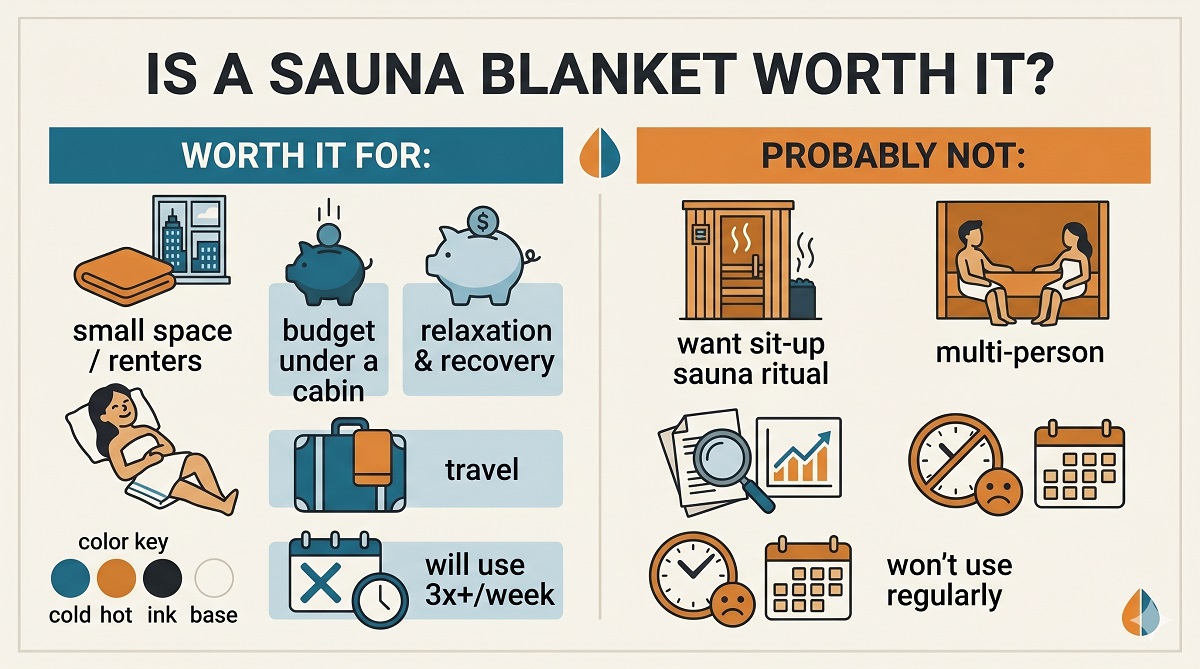
Buy a blanket if you’re short on space or rent, want infrared heat without a big spend, value relaxation and recovery over the sauna ritual, travel and want to take it with you, or simply want to test whether infrared heat suits you before committing to a cabin. Skip it (or buy a cabin instead) if you want the sit-up, whole-body, löyly-and-all sauna experience, you’ll use it with a partner, or you specifically want the activity with the strongest research behind it — which points to a traditional sauna.
If you do buy one
Choose on safety first: published third-party EMF/VOC testing, auto-shutoff, overheat protection, and a recognized safety mark — not the cheapest listing. Our best infrared sauna blankets guide ranks options on exactly that basis, and many are available on Amazon or direct from the brand. They’re also frequently HSA/FSA-eligible.
What the research actually says
Honesty matters here. The far-infrared heat a blanket uses is the same mechanism studied in infrared sauna cabins, and regular sauna bathing (mostly traditional) is associated with real relaxation and cardiovascular benefits. But rigorous studies on blankets specifically are scarce. What’s reasonable to expect: a genuine relaxation and stress-relief effect (many report better mood and sleep after evening sessions), improved circulation and a deep sweat, and eased muscle tension. What’s not supported: meaningful “detoxification” (your liver and kidneys handle that, not sweat) or fat loss (the scale drop is water). Treat a blanket as a relaxation-and-recovery tool with plausible wellness upside — not a medical device.
Blanket vs. studio vs. cabin
| Sauna blanket | Studio sessions | Infrared cabin | |
|---|---|---|---|
| Upfront | $400–$700 | $0 | $1,500–$9,000+ |
| Per session | Pennies (electricity) | $40–$75 | Pennies |
| Experience | Lie down, head out | Full room, sit up | Full room at home |
| Space | Folds away | None at home | Permanent footprint |
| Best for | Budget, small space, travel | Trying it, occasional use | The full ritual, frequent use |
If you’d use a studio more than a couple of times a month, a blanket pays for itself quickly; if you want the sit-up room experience daily, a cabin is the better long-term home.
How to get the most from a blanket
- Be consistent: 3–4 sessions a week of 20–40 minutes beats occasional marathons.
- Hydrate before and after, and always use a barrier towel or insert.
- Pair it with wind-down in the evening for relaxation, or with stretching after training.
- Keep it clean: wipe the interior after each use to prevent odor and prolong its life.
Common buyer mistakes
- Buying on price alone and ending up with an uncertified, possibly-recalled unit.
- Expecting weight loss or detox — then feeling let down by a tool that’s genuinely great for relaxation.
- Skipping the barrier layer and sweating onto the heating surface.
- Ignoring warranty/return terms on a $500+ purchase.
Is it just a fancy electric blanket?
No — and the difference matters. A household electric blanket warms its surface to keep you cozy at maybe 90–110°F. An infrared sauna blanket uses far-infrared heating elements built to warm your body more deeply and reach 150–175°F to induce a real sweat, with a waterproof, wipe-clean interior, session timers, multiple heat levels, and (on good models) overheat protection and shielded low-EMF wiring. You can’t safely substitute a regular electric blanket, and you shouldn’t try.
Maintenance & lifespan
Upkeep is light but real. Wipe the interior after each session, let it dry fully before folding, and store it loosely rather than crammed to protect the internal wiring. Always use a towel or insert as a sweat barrier — it keeps the inside cleaner and extends the blanket’s life. Treated well, a quality blanket lasts several years; the heating elements and controller are the parts that eventually wear, which is why a solid 2–5-year warranty is worth paying for.
The bottom line
An infrared sauna blanket is one of the best-value wellness buys for the right person: a fraction of a cabin’s price, easy to store and use, and genuinely relaxing when used regularly. The catch is safety — this is a category where the cheapest option can be the riskiest — so buy a tested, certified blanket, use it with a barrier and sensible sessions, and judge it on relaxation and recovery rather than detox or weight-loss promises. If you’re short on space, want infrared heat without a big spend, or want to test whether you enjoy it before buying a cabin, it’s an easy recommendation. If you crave the full sit-up sauna ritual or want the most-studied benefits, put the money toward a traditional sauna instead. Match it to your goal and it’s well worth it; buy it for the wrong reasons and it’ll gather dust.
FAQ
Are sauna blankets worth the money?
For the right person, yes — they’re the cheapest, most space-efficient way into regular infrared heat, and pay for themselves within a dozen or so sessions versus studio visits. They’re not worth it if you want the full sit-up sauna ritual, the strongest evidence base, or a multi-person experience.
What’s the downside of a sauna blanket?
You lie down with your head out rather than sitting in heat, sessions can feel confining, you’ll sweat into it (so cleanup and a barrier towel matter), and the category has had safety recalls — so brand and certifications matter a lot.
Is a sauna blanket as good as a real sauna?
It delivers similar far-infrared heat and sweating, but it’s a different experience — more “warm wrap” than sauna room. For whole-body ambient heat, löyly, and a shared ritual, a cabin wins; for price and portability, the blanket wins.
Do sauna blankets help you lose weight?
Not meaningfully. You’ll lose water weight in a session that returns when you rehydrate. Any real fat loss comes from diet and exercise, not heat — treat weight-loss marketing skeptically.
Sources
- Haven of Heat — sauna blanket benefits, evidence & cost-per-session. havenofheat.com
- Wareable — hands-on testing & honest take on weight-loss claims. wareable.com
Educational only. Codes and conditions vary — confirm locally and consult a licensed professional.