Are Cold Plunges Worth It? An Honest Cost-Benefit Look
Cold plunging is everywhere, the claims are big, and the tubs are expensive — so “is it actually worth it?” is the right question to ask before buying. Here’s an honest breakdown of the benefits, the real costs, and who it makes sense for.
The benefits that hold up
Stripping out the hype, the evidence best supports these (more detail in cold plunge benefits):
- Mood, focus & energy. Cold immersion produces a large, lasting rise in dopamine and norepinephrine — many people describe hours of improved mood and alertness. This is the standout, and it’s why people get hooked.
- Recovery & reduced soreness. Cold reliably lowers perceived muscle soreness and feels restorative (with one caveat below).
- Metabolic effects. Cold activates calorie-burning brown fat and is linked with better insulin sensitivity — useful for metabolic health, though not a weight-loss tool by itself.
- Resilience. Deliberately facing a tolerable stressor builds a real sense of mental toughness for many.
Two honest caveats: heavy cold right after strength training may blunt muscle gains (see cold therapy & recovery), and despite the longevity hype, current research does not show cold plunging extends lifespan.
The real costs
Be honest with yourself about all of them, not just the sticker price:
- Upfront: from under $150 (ice tub) to $5,000–$20,000+ (premium chiller units); a DIY tub-plus-chiller (~$1,000–$2,500) is the value sweet spot. See cold plunge cost.
- Running: ~$10–$45/month to run a chiller — far cheaper than $150–$250+/month buying ice for daily use.
- Time & discomfort: it’s cold, and the habit only pays off if you actually do it.
- Maintenance: water care and filtration (a few minutes a week).
Run your own numbers with our cost calculator — for regular users, a chiller setup usually beats ice within about a year.
Test it cheaply first
The smartest way to find out if it’s worth it for you is to spend almost nothing first. Cold showers capture much of the mood benefit for free. A simple ice bath in an insulated tub (or even a stock tank) lets you experience full immersion before committing to a chiller. If you find yourself looking forward to it after a few weeks, that’s your signal that a proper cold plunge is a worthwhile upgrade — for convenience, consistent temperature, and clean water without endless ice runs.
Who it’s worth it for
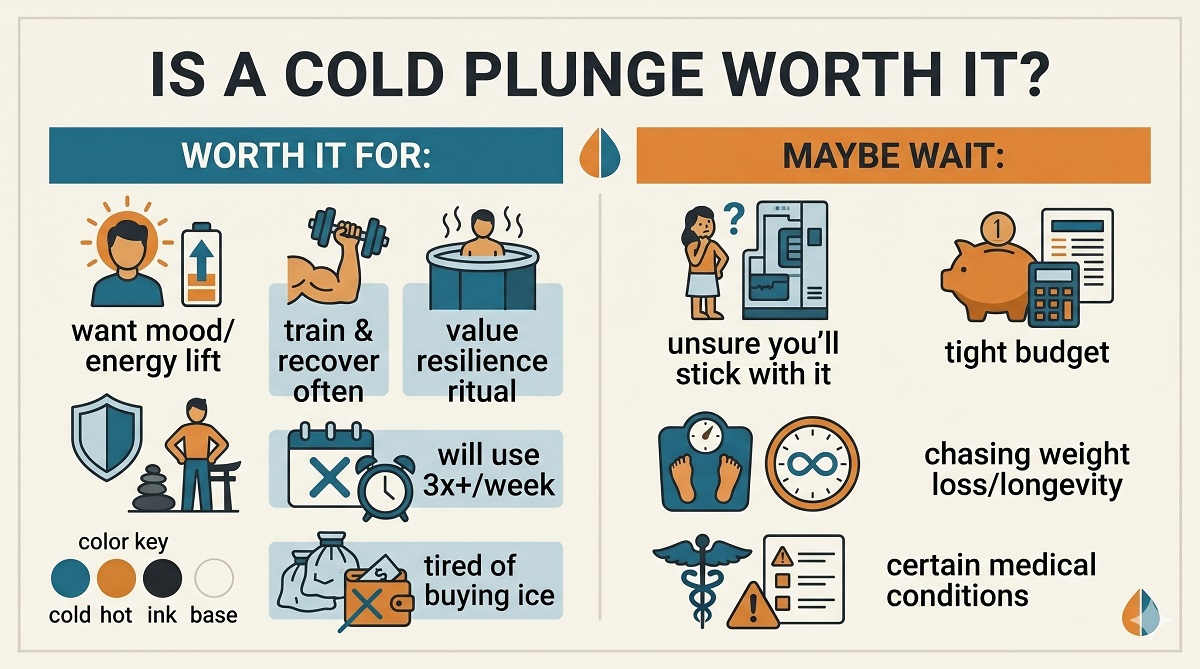
Worth it if you want the mood and energy lift, train and recover regularly, value the resilience ritual, and will realistically use it several times a week. Wait or skip if you’re not sure you’ll stick with it, you’re on a tight budget, or you’re buying it expecting weight loss or a longer life — those aren’t what the evidence supports. And if you have heart or blood-pressure conditions or are pregnant, talk to your doctor before starting.
What the research actually shows
The standout finding is on mood and alertness: cold immersion drives a large, sustained rise in dopamine (one study reported roughly a 250% increase) and norepinephrine, which many experience as hours of improved mood and focus. For recovery, cold reliably reduces perceived soreness (Bieuzen 2013). For metabolism, it activates brown fat and is linked with better insulin sensitivity, with measurable effects from roughly 11 minutes of cold immersion per week. The honest limits: much evidence is early or from small/specific groups, the clinical (depression/anxiety) evidence is still limited, and — worth repeating — cold plunging does not extend lifespan in current research.
The hidden costs people forget
- Electrical: a nearby GFCI outlet, sometimes an electrician.
- A solid, level, drainable spot — a filled tub plus a person can exceed 1,000 lb (see placement).
- Water care: filtration, sanitizer, occasional refills.
- Time: the habit only delivers if you actually do it several times a week.
- Climate: in hot regions a chiller works harder; in freezing ones you’ll manage freeze protection.
Cold plunge vs. the cheaper alternatives
| Option | Cost | Best for |
|---|---|---|
| Cold shower | Free | Testing cold exposure, daily mood lift |
| Ice bath (tub + ice) | Low upfront, $$$ ice | Trying full immersion |
| Chiller cold plunge | $$$ upfront, low run cost | A regular, convenient habit |
| Cryotherapy studio | $30–$60/session | Occasional, no maintenance |
Start cheap, and upgrade to a chiller plunge only once you know you’ll stick with it.
How to make sure it’s worth it
The biggest predictor of “worth it” is consistency. Put it somewhere convenient, stack it onto an existing routine (morning coffee, post-workout), start with short manageable dips, and aim for a few times a week. A plunge used daily is one of the best-value wellness purchases you can make; one that becomes an expensive cold tub in the garage is not. Be honest about which you’ll be before you buy.
Who should be cautious or skip it
Cold immersion is a genuine physiological stressor, so it isn’t for everyone. Talk to a doctor first — and take particular care — if you have heart disease, high or poorly-controlled blood pressure, a history of arrhythmia, Raynaud’s, or are pregnant. The “cold shock” response briefly spikes heart rate and blood pressure, which is exactly why people with cardiovascular conditions need medical guidance. If you’re cleared to try it, ease in gradually rather than starting with long, very cold sessions.
What a realistic first month looks like
Expectations shape whether it feels “worth it.” Most people start around 50–59°F for 1–2 minutes and find it genuinely hard at first — that’s normal. Over a few weeks the cold becomes more tolerable, sessions stretch toward 2–5 minutes, and the post-plunge mood lift becomes the thing you look forward to. You don’t need to chase colder-and-longer; consistency at a comfortable-for-you temperature beats heroics. By the end of a month you’ll know whether the mood and recovery benefits land for you — the honest test of whether a permanent setup is worth the money. Our beginner’s guide lays out a gentle progression.
The bottom line
A cold plunge earns its keep for people who actually use it — the mood and energy lift is real and, for many, becomes the highlight of the day, with recovery and resilience as bonuses. The honest risks to “worth it” are spending thousands before you know you’ll stick with it, and buying it for outcomes (weight loss, longevity) the evidence doesn’t back. So test it cheaply first with cold showers or an ice tub, be realistic about running costs and the cold itself, and upgrade to a proper chiller plunge once the habit sticks. Do that, and a home cold plunge is among the most rewarding wellness purchases you can make. Treat it as an impulse buy you might use twice, and it’s an expensive way to chill water. The deciding factor isn’t the tub — it’s you.
FAQ
Are cold plunges worth the money?
If you’ll use it regularly for mood, recovery or resilience, a home cold plunge is often worth it — it’s cheaper and far more convenient than ice baths or studio sessions over time. If you’re unsure you’ll stick with it, start cheaply with cold showers or an ice tub first.
What are the actual benefits of a cold plunge?
The best-supported are a strong, lasting mood and alertness lift and reduced perceived soreness; cold also activates calorie-burning brown fat and may improve insulin sensitivity. Evidence is still developing, and it does not extend lifespan.
How much does a cold plunge really cost?
From under $150 for an ice tub to $5,000–$20,000+ for premium chiller-equipped units, plus about $10–$45/month to run a chiller. A DIY tub-plus-chiller (~$1,000–$2,500) is the value sweet spot.
Is a cold plunge worth it if I have a cold shower?
Cold showers are a great, free way to test cold exposure and capture much of the mood benefit. A plunge adds full immersion, consistent temperature and a stronger stimulus — worth it if you want to go deeper, not essential to start.
Sources
- Healthline — evidence review of cold-water immersion benefits. healthline.com
- NPR (Life Kit) — scientists on which cold-plunge claims hold up. npr.org
- Bieuzen, Bleakley & Costello (2013), PLoS ONE — cold/contrast water therapy & recovery. doi:10.1371/journal.pone.0062356
Educational only. Codes and conditions vary — confirm locally and consult a licensed professional.