The Wim Hof Method & Cold Exposure: A Safety-First Guide
The Wim Hof Method (WHM) has brought breathwork and cold exposure to a huge audience. Here’s a clear, safety-first overview — and an honest look at the evidence.
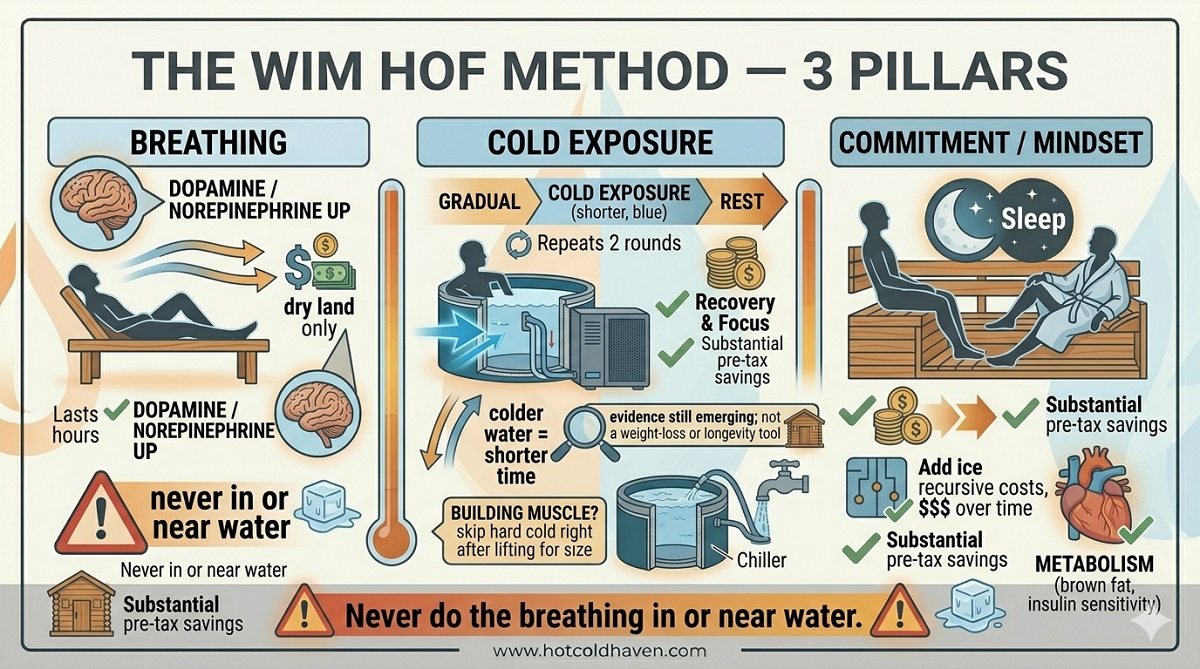
The three pillars
- Breathing: cycles of ~30–40 deep breaths followed by a breath-hold, repeated for several rounds. Done on dry land only.
- Cold exposure: gradual adaptation via cold showers and plunges — the same progressive approach we recommend generally.
- Commitment/mindset: consistency and focus to tie it together.
What the evidence says
Research is early but intriguing: a notable study suggested trained WHM practitioners could influence their autonomic nervous system and dampen a short-term inflammatory response — something once thought to be involuntary. Many people also report better mood, focus and stress resilience. Still, the overall evidence base is limited, and strong health claims outrun what’s been proven.
How to start safely
- Learn the breathing on dry land, seated or lying down, never near water.
- Build cold exposure separately and gradually — start with cold showers, then short plunges at manageable temperatures.
- Never plunge alone when learning, and never hyperventilate before getting in.
- Check with a doctor first if you have any cardiovascular or respiratory condition, or are pregnant.
What the breathing does — and its risk
The breathing cycles (rapid deep breaths followed by a breath-hold) lower the carbon dioxide in your blood, which can cause tingling, lightheadedness, and in some people fainting. On dry land, lying or sitting, that’s manageable. In or beside water it can be fatal — a faint underwater means drowning. This single physiological fact is why the breathing and the cold exposure are always done separately, and why we repeat the warning: never breathe near water.
A safe weekly starting point
If you want to try it, learn the breathing seated or lying down a few times a week, and build cold exposure on its own — cold showers first, then short plunges at manageable temperatures, following the same beginner progression we recommend generally. Stop any time you feel unwell, and check with a doctor first if you have a cardiovascular or respiratory condition, or are pregnant.
FAQ
What is the Wim Hof Method?
A practice combining three pillars: a specific deep-breathing technique, gradual cold exposure (cold showers and plunges), and commitment/mindset. It’s popularized by Wim Hof, ‘The Iceman.’
Is the Wim Hof Method safe?
The cold exposure is reasonably safe if you build up gradually and follow standard cold-plunge precautions. The breathing, however, can cause lightheadedness or fainting — so it must NEVER be done in or near water, or while driving.
Does the Wim Hof Method have proven benefits?
Some research suggests the breathing can influence the autonomic nervous system and short-term immune/inflammatory responses, and many users report mood and resilience benefits. The evidence base is still limited and early.
Can beginners try the Wim Hof Method?
Yes, but separately and safely: practice the breathing seated or lying down on dry land, and build cold exposure gradually starting with cold showers — never combine the two.
Sources
- Kox et al. (2014), PNAS — voluntary modulation of autonomic & immune response with WHM-style training. doi:10.1073/pnas.1322174111
- Psychiatry & Psychotherapy Podcast — review of cold exposure & the Wim Hof Method (evidence & cautions). psychiatrypodcast.com
Educational only. Codes and conditions vary — confirm locally and consult a licensed professional.