Cold Plunge Temperature: How Cold Should It Be?
“How cold should it be?” is the first question most people ask. Here’s a sensible, evidence-aligned answer by experience level.
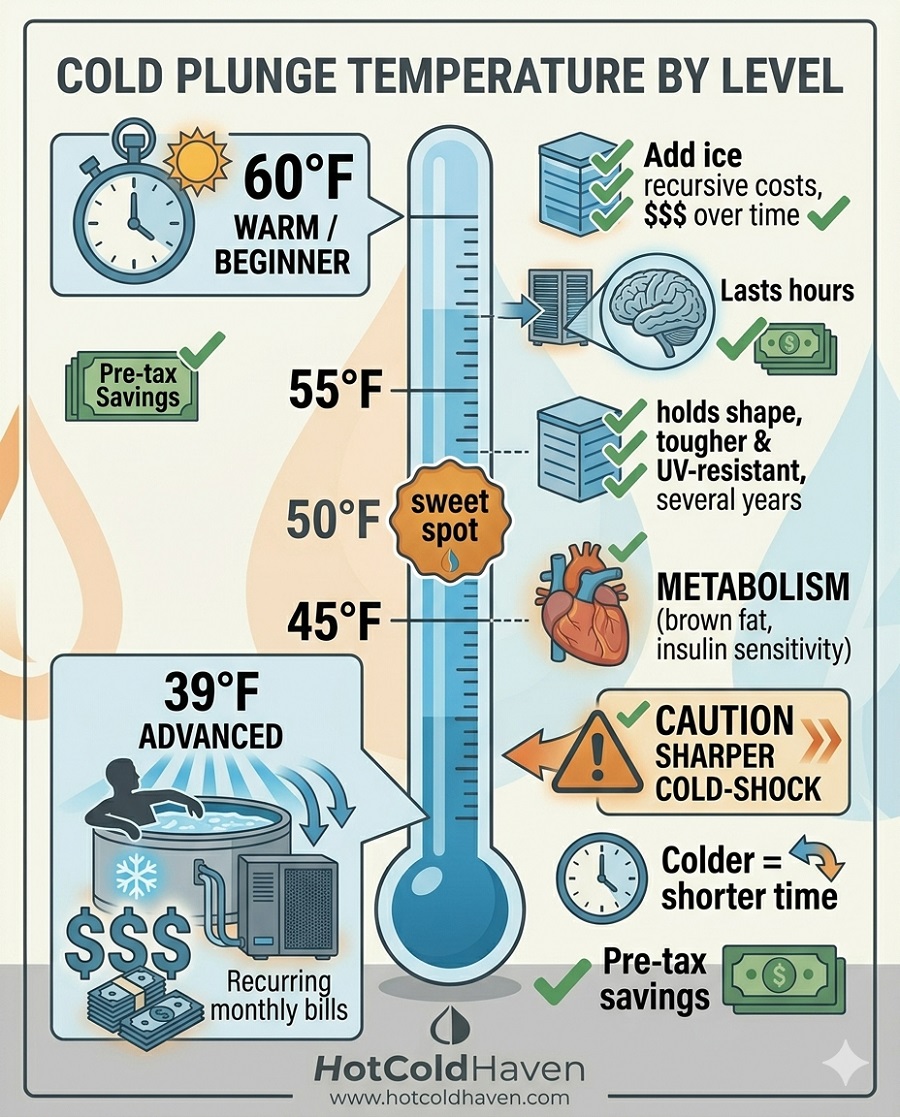
| Level | Temperature | Notes |
|---|---|---|
| Beginner | 55–60°F (13–15°C) | Still feels intense; short dips to start |
| Intermediate | 50–55°F (10–13°C) | The common “cold therapy” sweet spot |
| Advanced | 39–50°F (4–10°C) | Shorter times; more caution needed |
Why 50–59°F is the sweet spot
This range is cold enough to trigger the mood, alertness and recovery responses while staying manageable. Going colder doesn’t unlock extra benefits so much as shorten the time you need — and increase the demand on your body.
Colder = shorter
Temperature and time trade off: a brief dip at 45°F is a strong stimulus, while a gentler 55°F session takes longer for a similar effect. Match the two together — see how long to cold plunge.
The risk of going too cold too soon
Below about 47°F, the initial cold-shock response (a sharp spike in heart rate and blood pressure, and an urge to gasp) is stronger. Build down gradually rather than jumping into ice-cold water on day one.
Why temperature matters
Cold water pulls heat from your body far faster than cold air, which is what drives the responses people are after: blood vessels constrict, the nervous system fires, and — if it’s cold enough — you get the surge of norepinephrine and dopamine behind the mood and alertness lift. The key insight is that there’s a threshold, not a colder-is-always-better curve. Once the water is cold enough to be genuinely uncomfortable (for most people, the 50–59°F band), going further mainly shortens how long you can stay in and sharpens the cold-shock reaction — it doesn’t multiply the benefit.
How to trust your temperature reading
Two thermometers can disagree by several degrees, so it’s worth knowing what you’re actually plunging in:
- Chiller setpoint vs. real water temp: a chiller holds close to its setpoint, but verify the actual water temperature — especially in a poorly-insulated or uncovered tub.
- Where you read it: water stratifies slightly, so read near the middle after the pump has circulated, not off the surface.
- Digital vs. floating: a quality digital probe is more consistent than a cheap floating dial — useful if you’re tracking progress over weeks.
Match the temperature to your goal
You rarely need to chase the coldest possible water:
- Mood & alertness: any genuinely cold dip in the 50–59°F range works — the response is about the cold being uncomfortable, not about hitting a specific low number.
- Recovery: roughly 50–59°F for a few minutes is the range most recovery research uses (see cold therapy & recovery).
- Cold adaptation & resilience: consistency at a manageable temperature beats occasional brutal sessions — tolerance builds either way.
Common temperature mistakes
- Going too cold on day one — the cold-shock response is sharper below ~47°F; build down over weeks.
- Inconsistent temperatures — a wildly different temperature each session makes progress and safety hard to judge.
- Trusting one cheap thermometer — verify your reading, especially before going very cold.
FAQ
What temperature should a cold plunge be?
Most cold therapy happens at 50–59°F (10–15°C). Beginners should start around 55–60°F and work colder over time. Experienced users often go 45–50°F, and some lower — but colder isn’t necessary for benefits and raises risk.
Is colder always better for cold plunging?
No. Most documented benefits occur in the 50–59°F range; going much colder mainly means you need less time and face more risk. Below about 47°F the initial heart-rate and blood-pressure spike is sharper, so caution matters.
What’s a good cold plunge temperature for beginners?
Start around 55–60°F (13–15°C) for short dips, then gradually lower the temperature and extend time as your tolerance builds. The cold feels intense at first even at these ‘mild’ temperatures.
Does water temperature change how long I should stay in?
Yes — the colder the water, the less time you need. A minute at 45°F delivers a strong stimulus; the same effect at 55°F takes longer. See our how-long guide.
Sources
- Huberman Lab — deliberate cold exposure: temperature ranges & the colder-shorter principle. hubermanlab.com
- Longevity Foundation — cold-water immersion protocol (10–15°C, duration, frequency). longevity.foundation
- UF Health — cold-water immersion benefits & risks (cold-shock, below ~47°F caution). ufhealthjax.org
Educational only. Codes and conditions vary — confirm locally and consult a licensed professional.