Sauna Temperature Guide: How Hot Should It Be?
The “right” temperature depends on the type of sauna and your experience. Here’s how to set it.
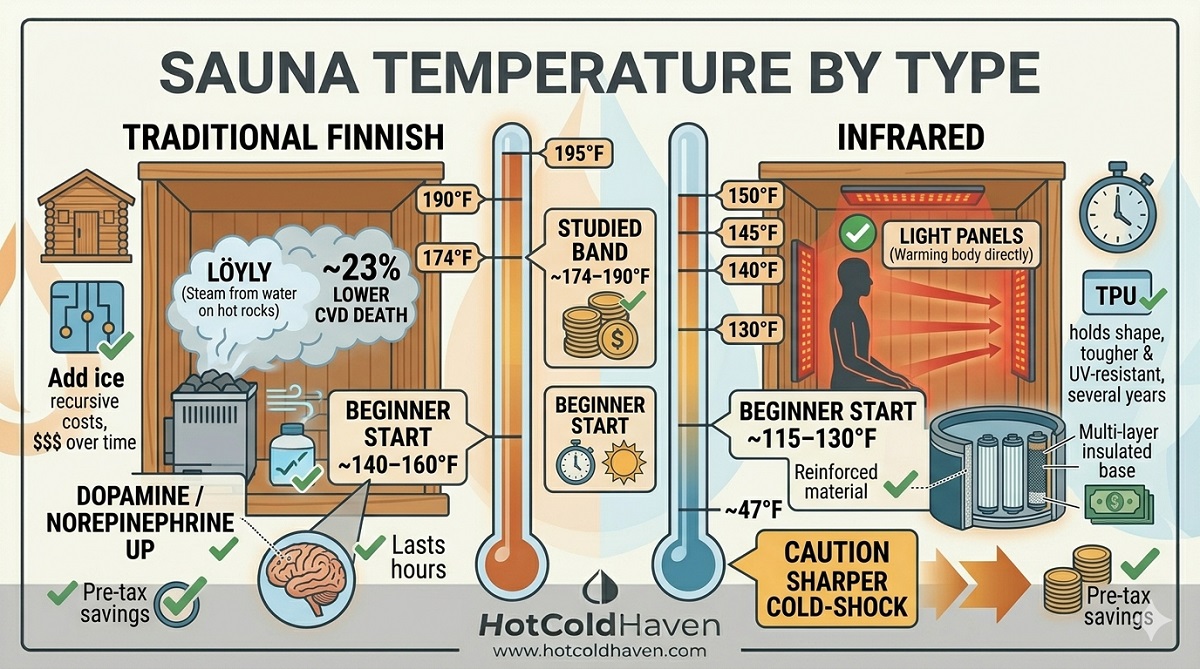
| Sauna type | Typical range | Beginner start |
|---|---|---|
| Traditional (Finnish) | 150–195°F (65–90°C) | ~140–160°F |
| Infrared | 120–150°F | ~115–130°F |
Traditional saunas
Finnish saunas heat the air (and rocks) to a hot 150–195°F; the research linking sauna use to health benefits mostly used temperatures around 174–190°F with sessions of ~20 minutes. You can pour water on the rocks (löyly) to raise humidity, which makes the heat feel more intense.
Infrared saunas
Because infrared warms your body directly, it runs cooler — 120–150°F — yet still produces a deep sweat. Many people find this gentler heat easier to tolerate for longer.
Start low, build up
Heat tolerance is trainable. Begin at the lower end with shorter sessions, hydrate well, and increase gradually. Chasing maximum temperature on day one just makes the experience unpleasant — and the benefits track more with regularity than with extreme heat.
Why the top bench is hotter
Heat rises, so a sauna’s air stratifies into layers — the top bench can sit 30–40°F hotter than the floor. That’s the whole point of tiered benches: sit higher for more intensity, lower to ease off. Beginners should start on a lower bench and move up as they acclimate, rather than cranking the thermostat.
Humidity changes everything (löyly)
In a traditional sauna the air temperature is only half the story. Pouring water on the hot rocks (löyly) spikes humidity, which makes a given temperature feel dramatically hotter as the moist air slows sweat from evaporating. A 175°F sauna with steam can feel more intense than a dry 195°F one. So if a session feels too harsh, lowering the temperature or adding less water both help. Infrared saunas don’t use water this way — part of why their lower air temperature still feels gentler.
Where to put the thermometer
For an accurate reading, mount the thermometer on the wall at about head height when seated on the top bench — not near the floor or directly above the heater, both of which mislead. Most pre-built saunas position it correctly; if you’re building your own, this placement matters for setting temperature safely.
Start low and acclimate
Heat tolerance is trainable. Begin at the lower end of the range with shorter 10–12 minute sessions, hydrate well, and raise temperature and time gradually over a few weeks. Pushing maximum heat on your first visit just makes it unpleasant — and as our benefits guide shows, the payoff tracks far more with regularity than with extreme temperature.
FAQ
What temperature should a sauna be?
A traditional Finnish sauna runs about 150–195°F (65–90°C), with the most-studied range around 174–190°F. Infrared saunas run cooler, about 120–150°F, because they heat your body directly rather than the air.
Why are infrared saunas cooler than traditional?
Infrared saunas warm your body directly with light, so they don’t need to heat the air to high temperatures. You get a comparable sweat at a gentler 120–150°F.
What’s the best sauna temperature for beginners?
Start at the lower end — around 140–160°F for traditional or 115–130°F for infrared — with shorter sessions, and increase as you acclimate. Comfort and hydration matter more than chasing maximum heat.
Does adding water (loyly) change the temperature?
Pouring water on the rocks of a traditional sauna raises humidity, which makes a given temperature feel hotter and more intense, even though the air temperature may dip briefly. Infrared saunas don’t use water this way.
Sources
- Atria Health Library — typical studied Finnish sauna temperatures (175–190°F, 10–20% humidity). atria.org
- Finnish Sauna Builders — infrared (120–140°F) vs traditional (170–190°F) temperatures. finnishsaunabuilders.com
Educational only. Codes and conditions vary — confirm locally and consult a licensed professional.