Red Light Therapy vs Infrared Sauna: The Honest Difference
These two get confused constantly — partly because both involve “infrared,” and partly because vendors selling one tend to talk down the other. Here’s a neutral comparison to help you choose (or combine) based on your actual goals.
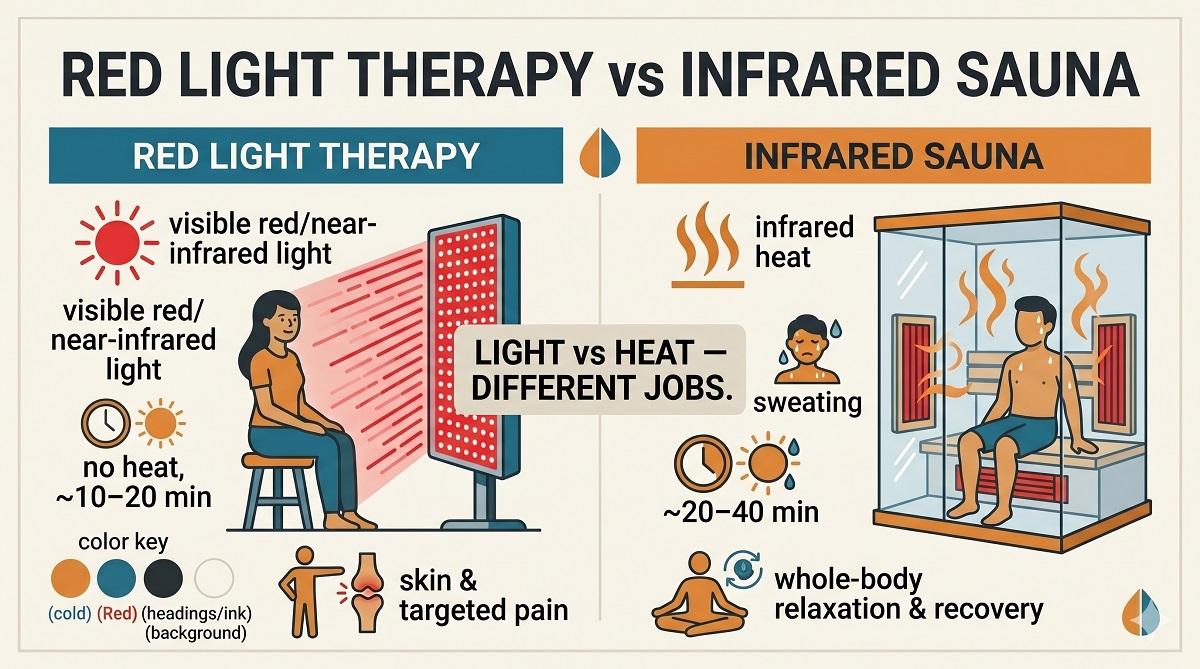
How each works
Red light therapy (photobiomodulation) exposes your skin to specific red and near-infrared wavelengths (roughly 600–850 nm) that are absorbed by your cells’ mitochondria, where the goal is to support cellular energy and repair. There’s no meaningful heat; sessions are short (about 10–20 minutes) and you stay comfortable.
Infrared saunas use infrared emitters to warm your body directly to about 120–150°F, raising your core temperature and inducing a sweat — a whole-body heat experience over 20–40 minutes (more in infrared vs traditional).
Benefits compared
Red light therapy has its most credible support in skin (collagen, tone, signs of aging, some acne) and localized pain and tissue recovery, with developing research in other areas. It’s targeted and gentle. Infrared saunas are about whole-body relaxation, recovery, eased muscle tension, and a deep sweat, with the broader (mostly traditional-sauna) literature linking regular sauna use to cardiovascular and longevity benefits.
Time, cost, space & experience
| Red light therapy | Infrared sauna | |
|---|---|---|
| Mechanism | Light (no heat) | Heat (infrared) |
| Session | ~10–20 min, comfortable | ~20–40 min, sweaty |
| Best for | Skin, targeted pain, recovery | Relaxation, whole-body recovery, sweat |
| Footprint | A panel; minimal space | A cabin (or a blanket); more space |
| Entry cost | Panels from a few hundred dollars | $1,500–$9,000+ (or a blanket) |
A home red light therapy panel is compact and relatively affordable, while infrared heat ranges from a budget infrared sauna blanket up to a full cabin.
Can you combine them?
Yes — they’re complementary, and many people use both for different goals (red light for skin/recovery, sauna for relaxation and sweat), generally in separate sessions. Some infrared cabins integrate red light panels for convenience; a dedicated panel usually delivers stronger, more targeted light if skin results are your priority.
Which should you choose?
- Skin health or a specific sore joint/muscle? Red light therapy.
- Whole-body relaxation, recovery and a sweat? Infrared sauna (or a blanket to start).
- Limited space or budget? A red light panel or a sauna blanket beats a full cabin.
- Want both? Run them separately, or look at an integrated cabin.
What the evidence says for each
Red light therapy has its most credible support in skin — studies indicate it can boost collagen and improve tone, texture and certain acne — and in localized pain and tissue recovery, with developing (less settled) research for hair growth and other uses. Results depend heavily on adequate light intensity at the right distance and consistent sessions over weeks. Infrared saunas have the broader (mostly traditional-sauna) literature behind regular heat exposure for cardiovascular and relaxation benefits, plus infrared-specific work on comfort, recovery and pain. Both fields are still maturing, and both attract marketing that runs ahead of the data — especially “detox” and “weight loss,” which neither reliably delivers.
Safety & who should take care
Red light therapy is low-risk for most people; use the eye protection the device recommends, and check with a doctor if you take photosensitizing medications or have a relevant skin or eye condition. Infrared saunas carry the usual heat cautions — hydrate, limit early sessions, avoid alcohol, and consult a doctor first if you have cardiovascular issues, are pregnant, or are heat-sensitive.
Cost & what to buy
Red light: quality home red light therapy panels range from around $100 for small targeted units to $600–$2,000+ for large full-body panels; look for published irradiance and the right wavelengths (red ~630–660 nm, near-infrared ~810–850 nm). Infrared heat: options run from a budget infrared sauna blanket (~$400–$700) up to a full cabin ($1,500–$9,000+). If budget and space are tight, a panel plus a blanket can cover both bases for far less than a cabin.
A simple way to use both
If you own both, a common approach is a red light session most days (10–20 minutes, for skin or a target area) and an infrared sauna a few times a week (20–40 minutes, for relaxation and recovery), kept as separate sessions. There’s no need to combine them in one sitting, and doing them apart lets you focus on each goal — they complement rather than replace each other.
Common myths about both
- “They’re basically the same thing.” No — one is light (no heat), the other is heat. Different jobs.
- “Red light melts fat or detoxes you.” Not supported — buy it for skin and targeted recovery.
- “Infrared saunas detox heavy metals.” Sweat’s detox role is minimal; the real wins are relaxation and recovery.
- “More heat or brighter light is always better.” Correct dose and consistency matter more than extremes.
Which should you buy first?
Starting from zero and can only buy one? Let your top goal decide. Skin concerns, a nagging joint, or post-workout tissue recovery point to a red light panel — compact, affordable, quick to use daily. If you mainly want to relax, de-stress, sleep better and sweat, an infrared option (start with a blanket if budget or space is tight) is the better first buy. Many people eventually own both because they solve different problems — but there’s no need to buy both at once.
Can one replace the other?
Not really — they target different things. A red light panel won’t give you a relaxing sweat, and a sauna won’t deliver targeted red/near-infrared light to your skin at the doses studied for skin and tissue benefits. If you only care about one outcome, buy the tool that matches it. If you want both relaxation-and-sweat and skin/recovery support, that’s a case for owning both — not expecting one to cover for the other.
The bottom line
Red light therapy and infrared saunas are complementary, not competing: choose red light for skin and targeted pain or recovery, and an infrared sauna for whole-body relaxation, recovery and a deep sweat. Ignore the overlapping marketing hype — especially detox and weight-loss claims — and buy based on the goal you actually have. If budget allows and you want both, a red light panel plus a sauna blanket covers a lot of ground for far less than a full cabin, used as separate sessions through your week.
FAQ
What’s the difference between red light therapy and an infrared sauna?
Red light therapy uses visible red and near-infrared light to stimulate cells (photobiomodulation) without heating you; an infrared sauna uses infrared to heat your body and make you sweat. One is a light treatment, the other a heat treatment — different mechanisms, different goals.
Which is better, red light therapy or an infrared sauna?
Neither is universally better. Red light therapy is better for targeted skin and localized pain goals; infrared saunas are better for whole-body relaxation, recovery and a deep sweat. Many people use both for different reasons.
Can you combine red light therapy and an infrared sauna?
Yes — they’re complementary and many do both, usually in separate sessions. Some sauna cabins build in red light panels, though a dedicated panel typically delivers stronger, more targeted light.
Does red light therapy make you sweat like a sauna?
No. Red light therapy doesn’t meaningfully heat you, so you won’t sweat. If sweating and whole-body heat are the goal, that’s a sauna, not red light.
Sources
- Cleveland Clinic — red light therapy: uses & evidence overview. clevelandclinic.org
- Laukkanen, Laukkanen & Kunutsor (2018), Mayo Clinic Proceedings — sauna health benefits review. review summary
Educational only. Codes and conditions vary — confirm locally and consult a licensed professional.