Cold Plunge Chiller Guide: How They Work & How to Choose
If you want a cold plunge you can use any time without hauling ice, a chiller is what makes it possible. Here’s how it works, what a full setup needs, and how to size and maintain one. Ready to buy? See our best cold plunge chillers.
How a chiller works
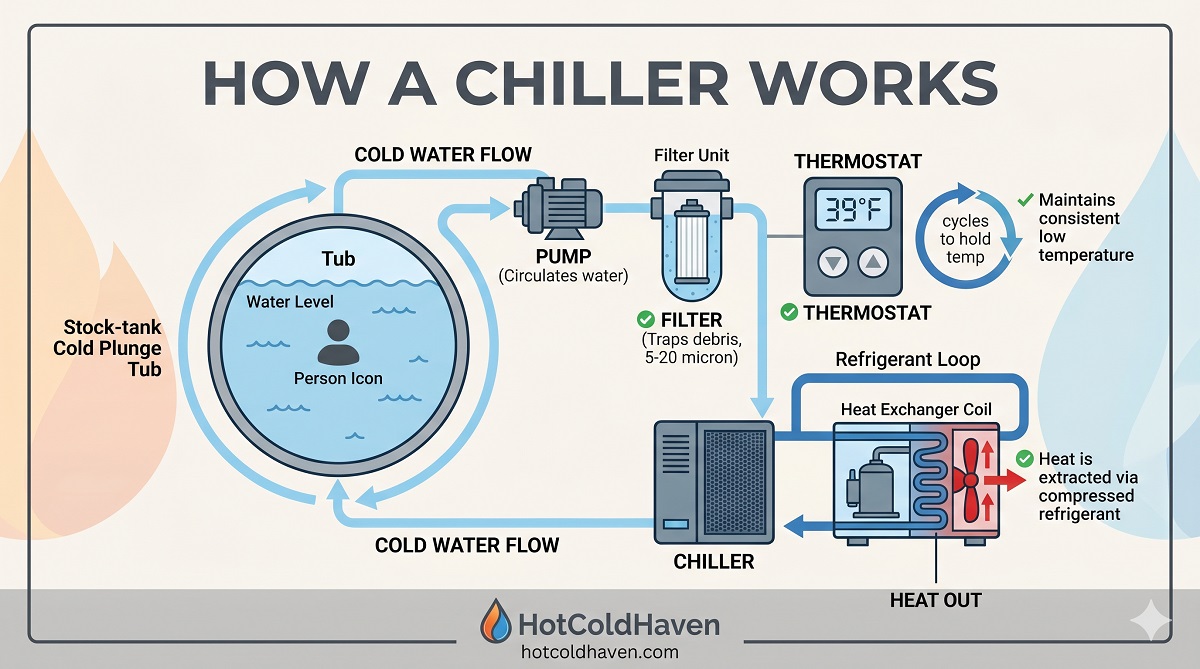
A water chiller runs the same refrigeration cycle as a fridge or air conditioner: a compressor and refrigerant draw heat out of water passing through a coil, and a pump circulates the chilled water back into your tub. Once it reaches your set temperature, it cycles on and off to maintain it rather than running flat out — which is why running costs are modest (see electricity costs).
The horsepower myth
The biggest misconception: that more HP means colder water. It doesn’t. A well-insulated tub will reach the same ~34°F floor on a 1/4 HP unit as on a 1 HP unit. What HP changes is how fast you get there and how well the chiller copes with heat, large volumes and poor insulation. So size to your climate and tub, not to a bigger number:
- 1/4 HP — fine for most insulated tubs in temperate climates.
- 1/2 HP — the sweet spot for faster cooling or larger tubs.
- 1 HP+ — big volumes, hot climates, sun-exposed or uninsulated tubs.
What a full setup needs
A finished tub bundles everything, but a standalone chiller (for a DIY build) usually needs:
- The chiller itself.
- A circulation pump, roughly 950–1,800 GPH.
- A filter housing with a 20–50 micron filter.
- Tubing & fittings to connect it to the tub.
- Optional ozone/UV sanitation — many chillers integrate this (see water treatment).
Building from scratch? Our DIY cold plunge guide walks through assembling these around a tub or stock tank.
Drop-in vs. inline
Most home chillers are external/inline units that sit beside the tub and circulate water through hoses — efficient and easy to service. Some all-in-one tubs use integrated cooling. Either way, the chiller needs airflow around it to shed heat, so don’t box it into a sealed cabinet.
Noise
A chiller runs a compressor and a fan, so it makes some noise — usually a steady hum in the range of a window air-conditioner or mini-fridge (roughly 40–55 dB for many home units, more under heavy load). It’s rarely an issue in a garage or outdoors, but for a chiller near a bedroom wall or in a small indoor room it’s worth checking the manufacturer’s decibel rating before buying, and leaving clearance around the unit so the fan isn’t strained. Quieter operation tends to track with better-built, higher-COP units.
Maintenance
Chillers are low-maintenance if you keep two things clean: the condenser coil (dust restricts heat exchange) and the water filter (a clog starves flow). Most performance complaints trace back to one of these. Keep the unit shaded and ventilated, and follow the maker’s guidance on sanitation chemicals — some components don’t tolerate chlorine.
FAQ
How does a cold plunge chiller work?
Like a compact air conditioner or mini-fridge: it pulls warm water across a refrigerant-cooled coil and circulates the chilled water back to the tub, cycling on and off to hold your set temperature.
Does a higher-HP chiller make water colder?
No. A 1/4 HP and a 1 HP unit can both reach about 34°F. Higher horsepower cools faster and copes better with heat and large or uninsulated tubs — it doesn’t lower the floor temperature.
What do I need besides the chiller?
A standalone setup typically needs a circulation pump (around 950–1,800 GPH), a filter housing with a 20–50 micron filter, and tubing/fittings. Some chillers include these; bare units don’t.
How do I maintain a chiller?
Keep the condenser coil clean, the water filtered, and airflow around the unit clear. Most chiller problems trace back to a dirty coil or clogged filter restricting performance.
Sources
- Bennett Carby — Best water chillers for cold plunging (HP, pumps, DIY setup). bennettcarby.com
- DIY Cold Plunge — Which chiller is best (HP sizing, component needs). diycoldplunge.com
- Sweat Decks — Chiller troubleshooting (condenser coil & filter maintenance). sweatdecks.com
Educational only. Codes and conditions vary — confirm locally and consult a licensed professional.