DIY Sauna: How to Build Your Own (Realistic Guide)
A DIY sauna is one of the more rewarding home projects — and a real money-saver if you’re handy. Here’s the realistic overview. For the detailed sequence, see how to install an indoor sauna.
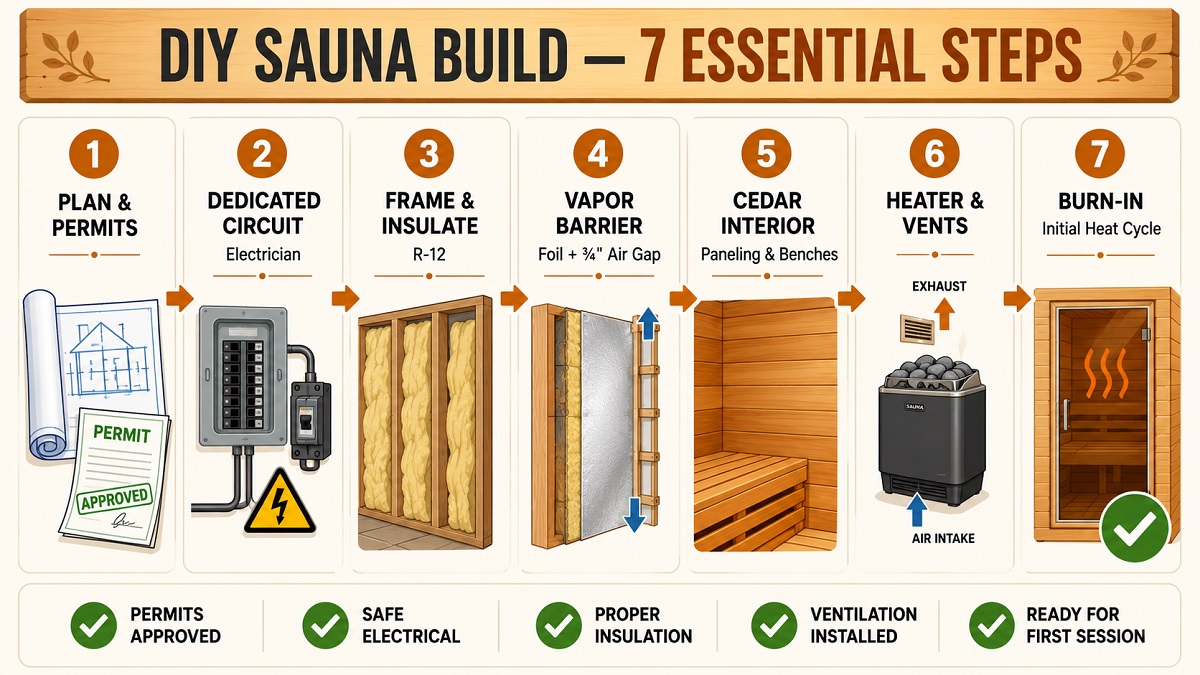
Two DIY routes
- Convert an existing space (a closet, spare room corner, or basement nook) — cheapest, since the structure exists.
- Build from scratch — frame a new room indoors or a cabin outdoors for full control over size and finish.
The core steps
- Plan & permits — confirm local requirements, especially for electrical.
- Dedicated circuit — 240V for a 3 kW+ heater; have a licensed electrician do the connection (see requirements).
- Frame & insulate to at least R-12.
- Foil vapor barrier on the warm side, seams taped, with a ¾” air gap.
- Cedar tongue-and-groove paneling and clear-grade benches (no exposed metal).
- Size & mount the heater (about 1 kW per 50 cu ft), add vents and a heat-rated light.
- Burn-in the new heater before first use.
Build vs buy
Building can beat prefab on cost — especially converting an existing space — but a kit saves time and guarantees correct assembly. Either way, a traditional sauna needs a properly sized, professionally connected heater. Compare totals in home sauna cost.
Wood species: what to use
Choose a wood that handles heat and moisture without warping, splintering, or getting too hot to touch. Western red cedar is the classic — aromatic, stable, and naturally rot-resistant. Aspen and basswood are pale, low-resin, and stay cooler to the touch (good for benches and for anyone sensitive to cedar’s scent). Nordic spruce or hemlock are budget-friendly options. Whatever you pick, use clear-grade boards for benches and keep no exposed metal on sitting or leaning surfaces — it gets hot enough to burn.
Costs & where to save
The biggest savings come from converting an existing space (no new structure) and doing the carpentry yourself; the heater and the electrician are the costs you shouldn’t cut. Buy the vapor barrier, foil tape, and insulation properly rather than improvising — they’re cheap relative to the damage a bad moisture seal causes. Compare your parts total against a prefab kit in home sauna cost before committing.
FAQ
Can I build my own sauna?
Yes. You can convert a spare room or closet, or build from scratch — framing, insulation, a foil vapor barrier, cedar paneling, benches, and a heater. The build is DIY-friendly, but have a licensed electrician make the heater’s final connection.
How much does a DIY sauna cost?
A DIY build can run roughly $1,500–$5,000 depending on size, wood and heater — often less than a comparable prefab, in exchange for your labor. Converting an existing space saves the most.
Is it cheaper to build or buy a sauna?
Building can be cheaper, especially if you convert an existing room and do the carpentry yourself. Prefab kits cost more but save time and guarantee a correct assembly. A DIY traditional sauna still needs a properly sized, professionally connected heater.
What’s the hardest part of a DIY sauna?
Two things: the electrical (a correctly sized, professionally connected dedicated circuit) and a continuous, well-sealed foil vapor barrier. Get those right and the rest is straightforward carpentry.
Sources
- Peak Primal Wellness — DIY sauna plans (framing, vapor barrier, ventilation, cost). peakprimalwellness.com
- Haven of Heat — sauna insulation & vapor barrier guide. havenofheat.com
Educational only. Codes and conditions vary — confirm locally and consult a licensed professional.